Single-oil monograph
Black pepper (Piper nigrum)
- Phototoxic No phototoxicity
- Pregnancy Caution
- Pets Caution
Published 2026-10-14 · adult ceiling 2% · shelf life 24 months
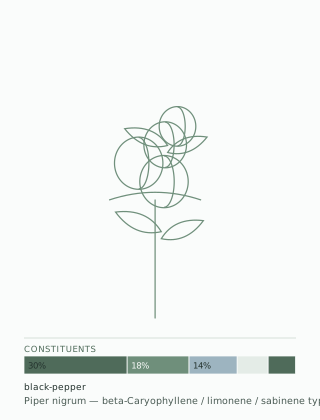
Black pepper oil is 30% beta-caryophyllene and 18% limonene, and it contains roughly 0.1% piperine — the pungent alkaloid is almost entirely absent, because it does not distil. That is the whole story of this oil: it smells like pepper, it warms the skin slightly, and it does not carry the pharmacology of the spice. Adult ceiling 2%.
Safe dilution matrix
Rows are the concentration, columns are the audience. Each cell carries two lines: drops per 10 ml of carrier oil, and whether this site advises that combination. Figures come from 1 ml = 20 drops, and the bold row is the ceiling for this oil.
| Dilution | Per 30 ml | Adult | Child 6+ | Pregnancy | Pets |
|---|---|---|---|---|---|
| 0.5% | 3 | 1 drops ✓ advised | 1 drops ✓ advised | 1 drops ✗ not advised | 1 drops ✗ not advised |
| 1% | 6 | 2 drops ✓ advised | 2 drops ✓ advised | 2 drops ✗ not advised | 2 drops ✗ not advised |
| 2% | 12 | 4 drops ✓ advised | 4 drops ✗ not advised | 4 drops ✗ not advised | 4 drops ✗ not advised |
What each concentration is normally for: 0.5% — Facial blends, sensitive or broken skin, children 6-15, first patch test · 1% — Everyday adult body and massage blends, daily leave-on use · 2% — Short-term localised adult use, 7 to 10 days then re-assess · 3% — Adult ceiling for robust oils, small area, short course only
Contraindications & handling
✓ no restriction · ! caution · ✗ avoid. An avoid row means choosing a different material, not lowering the concentration.
- ! Pregnancy & breastfeeding — caution
- ! Children under 16 — caution
- ! Households with pets — caution
- ✓ Epilepsy — ok
- ✓ Antihypertensive medication — ok
- ✓ Anticoagulant medication — ok
Four-step skin patch test
- Dilute 1 drop in 5 ml of carrier oil (1%).
- Apply 2 drops to the inner forearm.
- Cover for 24 hours.
- Read at 24 and 48 hours. A warm, tingling sensation from the caryophyllene is expected; redness that persists is not.
Botanical record
- Family
- Piperaceae · Piperaceae
- Botanical part
- fruit (peppercorn)
- Extraction
- steam-distillation
- Origin
- India (Malabar), Vietnam, Sri Lanka, Brazil
- Chemotype
- beta-Caryophyllene / limonene / sabinene type
- Phototoxicity
- No phototoxicity
- Shelf life
- 24 months
Principal constituents
- beta-Caryophyllene 30%
- Limonene 18%
- Sabinene 14%
- alpha-Pinene 9%
- beta-Pinene 8%
- Piperine 0.1%
Storage & oxidation
The 18% limonene fraction is what turns, and it turns faster than the caryophyllene that dominates the profile. Two years, capped and cool. An oxidised black pepper smells less like pepper and more like old paint thinner, which is a reasonably easy cue to catch.
Rotation & substitution
Black pepper is a warm spice note with a genuinely different chemistry from ginger and cardamom — caryophyllene rather than zingiberene or cineole — which makes it a good rotation partner for both. At 2% it is already the dominant note in a blend, so use it at 0.5-1% and swap it out every few weeks.
Adjacent materials
Pink pepper (Schinus molle)
Not a Piper at all — an Anacardiaceae species related to cashew