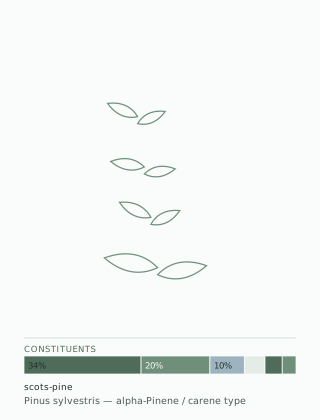
Pinus sylvestris
Scots pine
- alpha-Pinene / carene type
Scots pine is the conifer most widely sold as "pine needle oil" in Europe, and it is the cheapest way to put a forest note into a blend. It is also…
Quick reference
Rows are the carrier-oil volume, columns are the dilution, and each cell is the number of drops. Everything on this site uses one convention — 1 ml ≈ 20 drops — so this chart and every per-oil dose matrix can never drift apart.
| Carrier oil | 0.5% | 1% | 2% | 3% |
|---|---|---|---|---|
| 10 ml | 1 | 2 | 4 | 6 |
| 30 ml | 3 | 6 | 12 | 18 |
| 50 ml | 5 | 10 | 20 | 30 |
Pregnancy, children under 6, and rooms with cats or dogs — read the matching contraindication row before you blend.
One row per oil with its adult topical ceiling, converted at the same convention. A ceiling is a body figure; facial and long-term daily use always drops to 0.5% — 1 drop per 10 ml.
| Oil | Chemotype | Ceiling | Per 10 ml | Pregnancy | Pets |
|---|---|---|---|---|---|
| Pinus sylvestris | alpha-Pinene / carene type | 3% | 6 | caution | caution |
| Origanum vulgare | Carvacrol type; CT thymol and CT linalool exist | 2% | 4 | avoid | avoid |
| Thymus vulgaris | Thymol type (CT thymol); CT linalool and CT thujanol differ | 2% | 4 | avoid | avoid |
| Coriandrum sativum | Linalool-dominant (distinct from the leaf oil) | 3% | 6 | caution | caution |
| Foeniculum vulgare var. dulce | trans-Anethole / fenchone type (dulce = low fenchone) | 2% | 4 | avoid | caution |
| Helichrysum italicum | Neryl acetate / italidione type | 3% | 6 | caution | caution |
| Juniperus communis | alpha-Pinene / sabinene type | 3% | 6 | avoid | caution |
| Piper nigrum | beta-Caryophyllene / limonene / sabinene type | 2% | 4 | caution | caution |
| Elettaria cardamomum | 1,8-Cineole / terpinyl acetate type | 3% | 6 | caution | caution |
| Zingiber officinale | Zingiberene / sesquiphellandrene type | 3% | 6 | caution | caution |
| Chrysopogon zizanioides | Khusimol / vetiselinenol sesquiterpene alcohol type | 2% | 4 | caution | caution |
| Santalum album | alpha-Santalol / beta-santalol sesquiterpene alcohol type | 3% | 6 | caution | caution |
Monographs go live on an editorial calendar. The facet links below are plain text and switch by CSS :target — there is no scripted filtering and no filter dropdown.
Scots pine
Scots pine is the conifer most widely sold as "pine needle oil" in Europe, and it is the cheapest way to put a forest note into a blend. It is also…
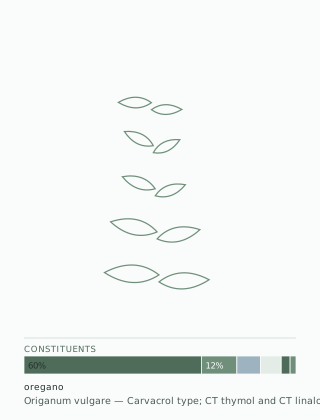
Oregano
Oregano is 60% carvacrol, the strongest phenol load on this site, and it is the oil most often recommended online at dilutions that would burn. It…
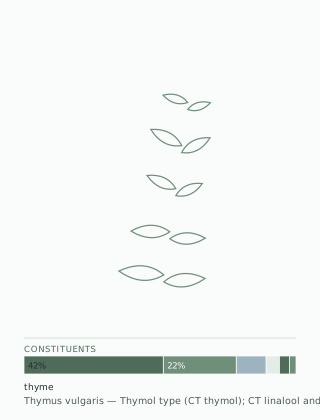
Thyme (thymol chemotype)
Thyme is the standard teaching example of why chemotype is a safety field and not a marketing one: CT thymol is 42% thymol with a 2% ceiling, CT…
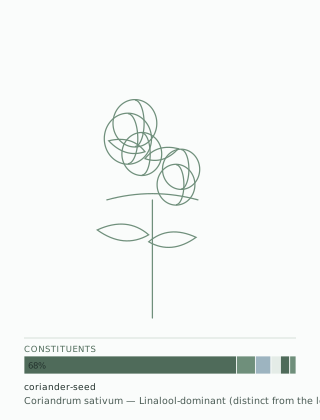
Coriander seed
Coriander seed oil is 68% linalool, which makes it far closer to lavender than to the herb of the same plant. It is cheap, it is one of the…
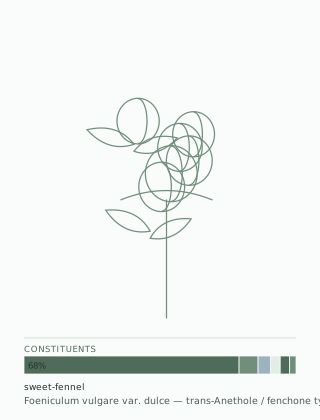
Sweet fennel
Sweet fennel is 68% trans-anethole, which puts it in the same chemical group as anise and star anise and gives it the same avoid rows. It is the…
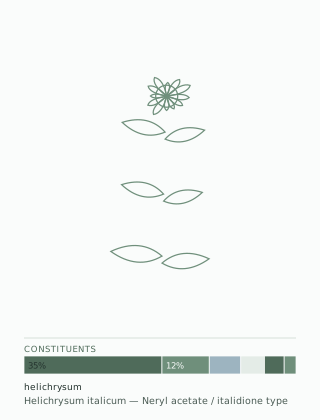
Helichrysum (immortelle)
Helichrysum is the most expensive oil in common aromatherapy use after rose, and it is sold on claims about bruising and skin repair that no…
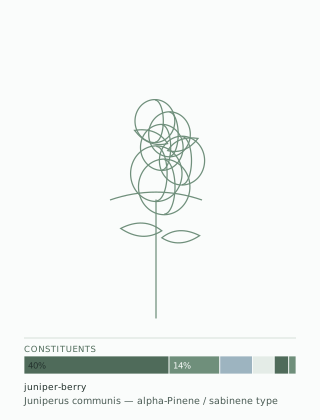
Juniper berry
Juniper berry is 40% alpha-pinene, which is why it smells like gin — it is what gin is flavoured with, and the oil is a distillation of the same…
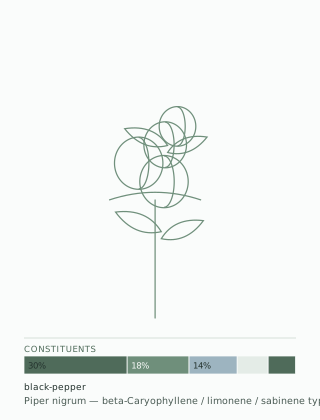
Black pepper
Black pepper oil is 30% beta-caryophyllene and 18% limonene, and it contains roughly 0.1% piperine — the pungent alkaloid is almost entirely…
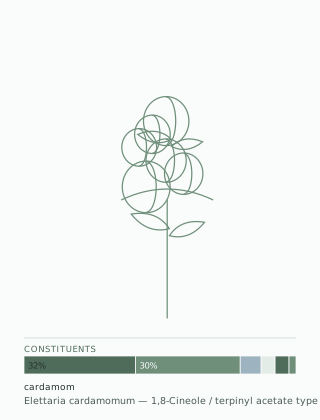
Cardamom
Cardamom oil is roughly a third 1,8-cineole and a third terpinyl acetate, which makes it a warm spice with a cool top note — and it puts it…
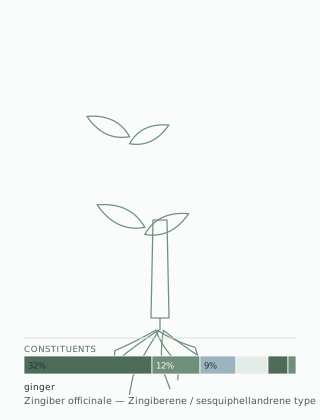
Ginger
Ginger is distilled from dried rhizome, and the resulting oil is 32% zingiberene — a sesquiterpene, not the gingerol that makes fresh ginger hot.…
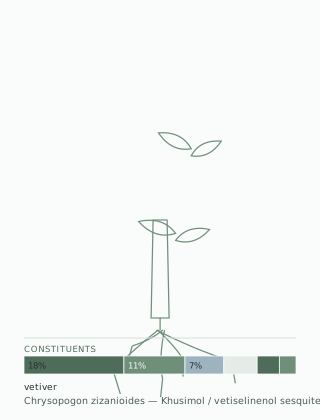
Vetiver
Vetiver is distilled from washed, dried roots, and it smells like it — smoke, wet earth, grapefruit peel and old wood. It is also the most…
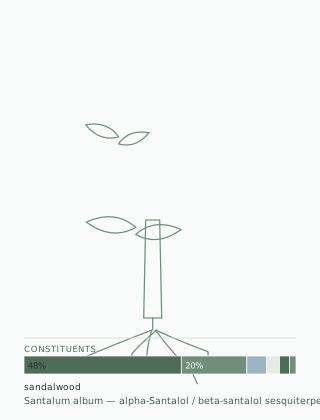
Indian sandalwood
Indian sandalwood is the most counterfeited oil on this site. Santalum album is a hemi-parasitic tree that takes 15 to 30 years to produce…
No blend recipes, no top-heart-base pyramids, no candle or diffuser craft instructions, no therapeutic claims. It does one thing: it sets out each single oil’s dilution ceiling, contraindicated groups, oxidation behaviour and patch-test steps, with every number derived from the single 1 ml ≈ 20 drops conversion.