Single-oil monograph
Helichrysum (Helichrysum italicum)
- Phototoxic No phototoxicity
- Pregnancy Caution
- Pets Caution
Published 2026-10-18 · adult ceiling 3% · shelf life 36 months
Helichrysum is the most expensive oil in common aromatherapy use after rose, and it is sold on claims about bruising and skin repair that no topical trial supports. It is also a genuinely well-tolerated ester oil with a distinctive curry-and-honey smell. Adult ceiling 3%, an Asteraceae cross-reactivity caveat, and a price that should make you suspicious of bargains.
Safe dilution matrix
Rows are the concentration, columns are the audience. Each cell carries two lines: drops per 10 ml of carrier oil, and whether this site advises that combination. Figures come from 1 ml = 20 drops, and the bold row is the ceiling for this oil.
| Dilution | Per 30 ml | Adult | Child 6+ | Pregnancy | Pets |
|---|---|---|---|---|---|
| 0.5% | 3 | 1 drops ✓ advised | 1 drops ✓ advised | 1 drops ✗ not advised | 1 drops ✗ not advised |
| 1% | 6 | 2 drops ✓ advised | 2 drops ✓ advised | 2 drops ✗ not advised | 2 drops ✗ not advised |
| 2% | 12 | 4 drops ✓ advised | 4 drops ✗ not advised | 4 drops ✗ not advised | 4 drops ✗ not advised |
| 3% | 18 | 6 drops ✓ advised | 6 drops ✗ not advised | 6 drops ✗ not advised | 6 drops ✗ not advised |
What each concentration is normally for: 0.5% — Facial blends, sensitive or broken skin, children 6-15, first patch test · 1% — Everyday adult body and massage blends, daily leave-on use · 2% — Short-term localised adult use, 7 to 10 days then re-assess · 3% — Adult ceiling for robust oils, small area, short course only
Contraindications & handling
✓ no restriction · ! caution · ✗ avoid. An avoid row means choosing a different material, not lowering the concentration.
- ! Pregnancy & breastfeeding — caution
- ! Children under 16 — caution
- ! Households with pets — caution
- ✓ Epilepsy — ok
- ✓ Antihypertensive medication — ok
- ! Anticoagulant medication — caution
Four-step skin patch test
- Dilute 1 drop in 5 ml of carrier oil (1%).
- Apply 2 drops to the inner forearm.
- Cover for 24 hours.
- Read at 24 and 48 hours. Helichrysum is Asteraceae, so if you react to ragweed or chrysanthemum, expect a higher baseline risk.
Botanical record
- Family
- Asteraceae · Asteraceae
- Botanical part
- flower
- Extraction
- steam-distillation
- Origin
- Corsica, Bosnia, Croatia, France (Provence)
- Chemotype
- Neryl acetate / italidione type
- Phototoxicity
- No phototoxicity
- Shelf life
- 36 months
Principal constituents
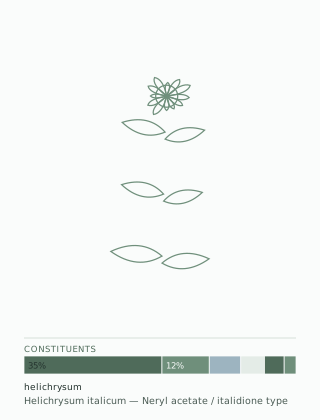
- Neryl acetate 35%
- gamma-Curcumene 12%
- Italidione I 8%
- alpha-Pinene 6%
- Limonene 5%
- Nerol 3%
Storage & oxidation
Neryl acetate is an ester and the italidiones are diketones; neither forms hydroperoxides readily, and the limonene fraction is only 5%. Helichrysum is one of the best-keeping flower oils, and three years is genuinely conservative. It darkens from pale yellow to a deep red-brown with age, which is a colour change and not a defect.
Rotation & substitution
Helichrysum is expensive enough that most people use it sparingly and rarely build a dependence on it. If you use it regularly, rotate with lavender or frankincense rather than with another Asteraceae — German chamomile, yarrow and Roman chamomile all share the family's cross-reactivity risk.
Adjacent materials
Corsican versus Balkan helichrysum
Corsican material is the reference for the honeyed neryl acetate profile and costs several times more; Balkan material is more camphoraceous and sharper. Not identical.