Single-oil monograph
Thyme (Thymus vulgaris, thymol chemotype)
- Phototoxic No phototoxicity
- Pregnancy Avoid
- Pets Avoid
Published 2026-10-24 · adult ceiling 2% · shelf life 24 months
Thyme is the standard teaching example of why chemotype is a safety field and not a marketing one: CT thymol is 42% thymol with a 2% ceiling, CT linalool is linalool-dominant with a 3% ceiling, and both are sold as "thyme oil". This monograph is written for the thymol type, which is the one most commonly sold as a commodity.
Safe dilution matrix
Rows are the concentration, columns are the audience. Each cell carries two lines: drops per 10 ml of carrier oil, and whether this site advises that combination. Figures come from 1 ml = 20 drops, and the bold row is the ceiling for this oil.
| Dilution | Per 30 ml | Adult | Child 6+ | Pregnancy | Pets |
|---|---|---|---|---|---|
| 0.5% | 3 | 1 drops ✓ advised | 1 drops ✗ not advised | 1 drops ✗ not advised | 1 drops ✗ not advised |
| 1% | 6 | 2 drops ✓ advised | 2 drops ✗ not advised | 2 drops ✗ not advised | 2 drops ✗ not advised |
| 2% | 12 | 4 drops ✓ advised | 4 drops ✗ not advised | 4 drops ✗ not advised | 4 drops ✗ not advised |
What each concentration is normally for: 0.5% — Facial blends, sensitive or broken skin, children 6-15, first patch test · 1% — Everyday adult body and massage blends, daily leave-on use · 2% — Short-term localised adult use, 7 to 10 days then re-assess · 3% — Adult ceiling for robust oils, small area, short course only
Contraindications & handling
✓ no restriction · ! caution · ✗ avoid. An avoid row means choosing a different material, not lowering the concentration.
- ✗ Pregnancy & breastfeeding — avoid
- ✗ Children under 16 — avoid
- ✗ Households with pets — avoid
- ✓ Epilepsy — ok
- ! Antihypertensive medication — caution
- ✗ Anticoagulant medication — avoid
Four-step skin patch test
- Dilute 1 drop in 10 ml of carrier oil (0.5%) — thyme is the strongest irritant on this site at concentration.
- Apply 1 drop of that blend to the inner forearm.
- Cover for 24 hours.
- Read at 24 and 48 hours. Burning within the first hour means wash with carrier oil and stop; do not proceed to 1%.
The 0.5% patch step is not a formality for this oil. Thymol at 42% is the highest phenol load on the site.
Botanical record
- Family
- Lamiaceae · Lamiaceae
- Botanical part
- leaf and flowering top
- Extraction
- steam-distillation
- Origin
- Spain, France (Provence), Morocco, Turkey
- Chemotype
- Thymol type (CT thymol); CT linalool and CT thujanol differ
- Phototoxicity
- No phototoxicity
- Shelf life
- 24 months
Principal constituents
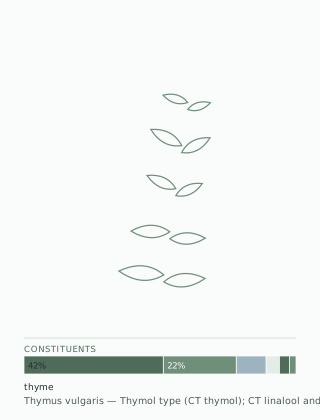
- Thymol 42%
- para-Cymene 22%
- gamma-Terpinene 9%
- Linalool 4%
- Carvacrol 3%
- beta-Caryophyllene 2%
Storage & oxidation
Thymol is a phenol and para-cymene is its precursor; oxidation of the terpinene fraction pushes the oil further toward cymene over time, which flattens the smell without making it dramatically more hazardous. Two years. The irritation risk from a fresh bottle is already the limiting factor here, not the ageing.
Rotation & substitution
Thyme, oregano and savory all carry high phenol loads, and rotating among them is the same exposure under different names. Thyme should be rotated with lavender or tea tree, used for short courses rather than continuously, and never used on the same patch of skin for weeks.
Adjacent materials
Thyme CT linalool
Linalool-dominant rather than thymol-dominant