Single-oil monograph
Coriander seed (Coriandrum sativum)
- Phototoxic No phototoxicity
- Pregnancy Caution
- Pets Caution
Published 2026-10-22 · adult ceiling 3% · shelf life 24 months
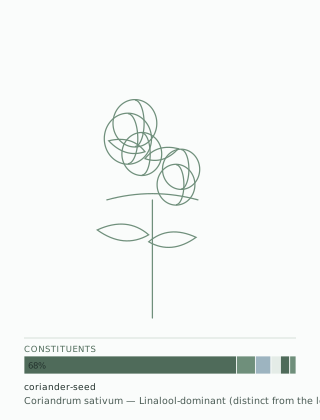
Coriander seed oil is 68% linalool, which makes it far closer to lavender than to the herb of the same plant. It is cheap, it is one of the better-tolerated oils, and it is the clearest illustration on this site of why the same plant can produce two unrelated materials. Adult ceiling 3%, with a real oxidation caveat.
Safe dilution matrix
Rows are the concentration, columns are the audience. Each cell carries two lines: drops per 10 ml of carrier oil, and whether this site advises that combination. Figures come from 1 ml = 20 drops, and the bold row is the ceiling for this oil.
| Dilution | Per 30 ml | Adult | Child 6+ | Pregnancy | Pets |
|---|---|---|---|---|---|
| 0.5% | 3 | 1 drops ✓ advised | 1 drops ✓ advised | 1 drops ✓ advised | 1 drops ✗ not advised |
| 1% | 6 | 2 drops ✓ advised | 2 drops ✓ advised | 2 drops ✗ not advised | 2 drops ✗ not advised |
| 2% | 12 | 4 drops ✓ advised | 4 drops ✗ not advised | 4 drops ✗ not advised | 4 drops ✗ not advised |
| 3% | 18 | 6 drops ✓ advised | 6 drops ✗ not advised | 6 drops ✗ not advised | 6 drops ✗ not advised |
What each concentration is normally for: 0.5% — Facial blends, sensitive or broken skin, children 6-15, first patch test · 1% — Everyday adult body and massage blends, daily leave-on use · 2% — Short-term localised adult use, 7 to 10 days then re-assess · 3% — Adult ceiling for robust oils, small area, short course only
Contraindications & handling
✓ no restriction · ! caution · ✗ avoid. An avoid row means choosing a different material, not lowering the concentration.
- ! Pregnancy & breastfeeding — caution
- ✓ Children under 16 — ok
- ! Households with pets — caution
- ✓ Epilepsy — ok
- ✓ Antihypertensive medication — ok
- ✓ Anticoagulant medication — ok
Four-step skin patch test
- Dilute 1 drop in 5 ml of carrier oil (1%).
- Apply 2 drops to the inner forearm.
- Cover for 24 hours.
- Read at 24 and 48 hours, and patch test every new bottle — the linalool content means the oxidation state of the bottle matters more than the brand.
Botanical record
- Family
- Apiaceae · Apiaceae
- Botanical part
- seed (ripe fruit)
- Extraction
- steam-distillation
- Origin
- Russia, Ukraine, Bulgaria, Egypt, Morocco
- Chemotype
- Linalool-dominant (distinct from the leaf oil)
- Phototoxicity
- No phototoxicity
- Shelf life
- 24 months
Principal constituents
- Linalool 68%
- alpha-Pinene 6%
- gamma-Terpinene 5%
- Camphor 3%
- Geranyl acetate 3%
- Limonene 2%
Storage & oxidation
At 68% linalool this is the second-highest linalool oil on this site after neroli, and linalool oxidises into linalool hydroperoxide, one of the two main sensitisers found in household bottles. Coriander seed is cheap, which makes people keep it for years; that is the wrong economy here. Two years, and re-buy rather than stretching it.
Rotation & substitution
Coriander seed is linalool-dominant, which puts it in the same functional slot as lavender, clary sage and neroli. Rotating among those four is not a rotation in the sense this site means; pair coriander seed with a wood or a citrus instead and keep the linalool load down.
Adjacent materials
Coriander leaf (cilantro) oil
A completely different oil — decanal and decenol dominant