Single-oil monograph
Ginger (Zingiber officinale)
- Phototoxic Dose-dependent phototoxicity
- Pregnancy Caution
- Pets Caution
Published 2026-10-10 · adult ceiling 3% · shelf life 36 months
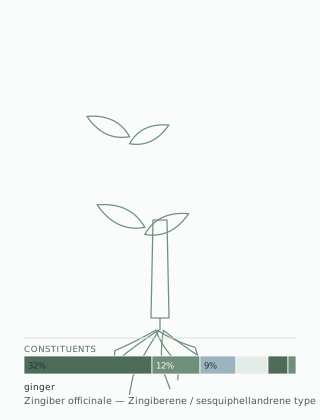
Ginger is distilled from dried rhizome, and the resulting oil is 32% zingiberene — a sesquiterpene, not the gingerol that makes fresh ginger hot. That distinction matters because gingerol is what the oral research is about, and gingerol is barely present in the distilled oil. Adult ceiling 3%, with a documented anticoagulant caution.
Safe dilution matrix
Rows are the concentration, columns are the audience. Each cell carries two lines: drops per 10 ml of carrier oil, and whether this site advises that combination. Figures come from 1 ml = 20 drops, and the bold row is the ceiling for this oil.
| Dilution | Per 30 ml | Adult | Child 6+ | Pregnancy | Pets |
|---|---|---|---|---|---|
| 0.5% | 3 | 1 drops ✓ advised | 1 drops ✓ advised | 1 drops ✓ advised | 1 drops ✗ not advised |
| 1% | 6 | 2 drops ✓ advised | 2 drops ✓ advised | 2 drops ✗ not advised | 2 drops ✗ not advised |
| 2% | 12 | 4 drops ✓ advised | 4 drops ✗ not advised | 4 drops ✗ not advised | 4 drops ✗ not advised |
| 3% | 18 | 6 drops ✓ advised | 6 drops ✗ not advised | 6 drops ✗ not advised | 6 drops ✗ not advised |
What each concentration is normally for: 0.5% — Facial blends, sensitive or broken skin, children 6-15, first patch test · 1% — Everyday adult body and massage blends, daily leave-on use · 2% — Short-term localised adult use, 7 to 10 days then re-assess · 3% — Adult ceiling for robust oils, small area, short course only
Contraindications & handling
✓ no restriction · ! caution · ✗ avoid. An avoid row means choosing a different material, not lowering the concentration.
- ! Pregnancy & breastfeeding — caution
- ! Children under 16 — caution
- ! Households with pets — caution
- ✓ Epilepsy — ok
- ! Antihypertensive medication — caution
- ✗ Anticoagulant medication — avoid
Four-step skin patch test
- Dilute 1 drop in 5 ml of carrier oil (1%).
- Apply 2 drops to the inner forearm.
- Cover for 24 hours, keeping the site out of direct sun.
- Read at 24 and 48 hours. Ginger carries a mild photosensitivity caution on some reference lists, so the 48-hour read after light exposure matters.
Botanical record
- Family
- Zingiberaceae · Zingiberaceae
- Botanical part
- rhizome
- Extraction
- steam-distillation (dried rhizome)
- Origin
- India, China, Nigeria, Indonesia
- Chemotype
- Zingiberene / sesquiphellandrene type
- Phototoxicity
- Dose-dependent phototoxicity
- Shelf life
- 36 months
Principal constituents
- Zingiberene 32%
- Sesquiphellandrene 12%
- beta-Bisabolene 9%
- ar-Curcumene 8%
- alpha-Zingiberene 5%
- Geranial 2%
Storage & oxidation
Ginger is a sesquiterpene-dominant rhizome oil with a small aldehyde fraction (geranial and neral) that darkens and thickens over time. It does not form hydroperoxides readily. Three years is a fair figure; the smell moving from bright-lemon-ginger toward flat and resinous is the signal to replace it.
Rotation & substitution
Ginger is a warming note used mostly in winter blends, at 1% as a middle note under a citrus top and a wood base. Because it is sesquiterpene-dominant it tolerates regular use, but it is also one of the more stimulating oils on skin, so rotate it out if you notice any warmth that persists after application.
Adjacent materials
Cardamom (Elettaria cardamomum) · monograph
Same family