Single-oil monograph
Oregano (Origanum vulgare, carvacrol chemotype)
- Phototoxic No phototoxicity
- Pregnancy Avoid
- Pets Avoid
Published 2026-10-26 · adult ceiling 2% · shelf life 24 months
Oregano is 60% carvacrol, the strongest phenol load on this site, and it is the oil most often recommended online at dilutions that would burn. It is also the oil where the gap between "antimicrobial in a petri dish" and "safe on a person" is widest. Adult ceiling 2%, avoid for pregnancy, children and pets, and a 0.5% patch test before anything else.
Safe dilution matrix
Rows are the concentration, columns are the audience. Each cell carries two lines: drops per 10 ml of carrier oil, and whether this site advises that combination. Figures come from 1 ml = 20 drops, and the bold row is the ceiling for this oil.
| Dilution | Per 30 ml | Adult | Child 6+ | Pregnancy | Pets |
|---|---|---|---|---|---|
| 0.5% | 3 | 1 drops ✓ advised | 1 drops ✗ not advised | 1 drops ✗ not advised | 1 drops ✗ not advised |
| 1% | 6 | 2 drops ✓ advised | 2 drops ✗ not advised | 2 drops ✗ not advised | 2 drops ✗ not advised |
| 2% | 12 | 4 drops ✓ advised | 4 drops ✗ not advised | 4 drops ✗ not advised | 4 drops ✗ not advised |
What each concentration is normally for: 0.5% — Facial blends, sensitive or broken skin, children 6-15, first patch test · 1% — Everyday adult body and massage blends, daily leave-on use · 2% — Short-term localised adult use, 7 to 10 days then re-assess · 3% — Adult ceiling for robust oils, small area, short course only
Contraindications & handling
✓ no restriction · ! caution · ✗ avoid. An avoid row means choosing a different material, not lowering the concentration.
- ✗ Pregnancy & breastfeeding — avoid
- ✗ Children under 16 — avoid
- ✗ Households with pets — avoid
- ✓ Epilepsy — ok
- ! Antihypertensive medication — caution
- ✗ Anticoagulant medication — avoid
Four-step skin patch test
- Dilute 1 drop in 10 ml of carrier oil (0.5%). Never test oregano at 1% first.
- Apply 1 drop of that blend to the inner forearm.
- Cover for 24 hours.
- Read at 24 and 48 hours. Oregano at 0.5% still produces warmth on many people; burning is different and means wash it off.
Botanical record
- Family
- Lamiaceae · Lamiaceae
- Botanical part
- leaf and flowering top
- Extraction
- steam-distillation
- Origin
- Turkey, Greece, Spain, Morocco
- Chemotype
- Carvacrol type; CT thymol and CT linalool exist
- Phototoxicity
- No phototoxicity
- Shelf life
- 24 months
Principal constituents
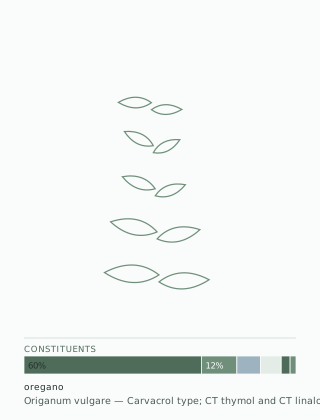
- Carvacrol 60%
- Thymol 12%
- gamma-Terpinene 8%
- para-Cymene 7%
- beta-Caryophyllene 3%
- Linalool 2%
Storage & oxidation
Carvacrol at 60% is the highest phenol load on this site, and phenols are stable; the cymene and terpinene fractions shift slowly. Two years. As with thyme, ageing is not the limiting factor — the fresh oil is already at the top of the irritation scale, and an old bottle is not meaningfully worse.
Rotation & substitution
Oregano, thyme and savory are the phenol trio and must not be used as each other's rotation. Oregano is the strongest of the three at 60% carvacrol. Rotate it with lavender or tea tree, use it in short courses of a week or less, and never on the same patch of skin for longer than that.
Adjacent materials
Marjoram
Same genus