Single-oil monograph
Vetiver (Chrysopogon zizanioides)
- Phototoxic No phototoxicity
- Pregnancy Caution
- Pets Caution
Published 2026-10-08 · adult ceiling 2% · shelf life 60 months
Vetiver is distilled from washed, dried roots, and it smells like it — smoke, wet earth, grapefruit peel and old wood. It is also the most tenacious oil on this site, the one with the fewest reactive constituents, and the one most often sold adulterated with a synthetic vetiveryl acetate. Two per cent adult ceiling; sixty months; no phototoxicity.
Safe dilution matrix
Rows are the concentration, columns are the audience. Each cell carries two lines: drops per 10 ml of carrier oil, and whether this site advises that combination. Figures come from 1 ml = 20 drops, and the bold row is the ceiling for this oil.
| Dilution | Per 30 ml | Adult | Child 6+ | Pregnancy | Pets |
|---|---|---|---|---|---|
| 0.5% | 3 | 1 drops ✓ advised | 1 drops ✓ advised | 1 drops ✓ advised | 1 drops ✓ advised |
| 1% | 6 | 2 drops ✓ advised | 2 drops ✓ advised | 2 drops ✗ not advised | 2 drops ✗ not advised |
| 2% | 12 | 4 drops ✓ advised | 4 drops ✗ not advised | 4 drops ✗ not advised | 4 drops ✗ not advised |
What each concentration is normally for: 0.5% — Facial blends, sensitive or broken skin, children 6-15, first patch test · 1% — Everyday adult body and massage blends, daily leave-on use · 2% — Short-term localised adult use, 7 to 10 days then re-assess · 3% — Adult ceiling for robust oils, small area, short course only
Contraindications & handling
✓ no restriction · ! caution · ✗ avoid. An avoid row means choosing a different material, not lowering the concentration.
- ! Pregnancy & breastfeeding — caution
- ! Children under 16 — caution
- ! Households with pets — caution
- ✓ Epilepsy — ok
- ✓ Antihypertensive medication — ok
- ✓ Anticoagulant medication — ok
Four-step skin patch test
- Dilute 1 drop in 5 ml of carrier oil (1%). Vetiver is extremely thick; warm the bottle and use a pipette if you can.
- Apply 2 drops to the inner forearm.
- Cover for 24 hours.
- Read at 24 and 48 hours. Reactions are rare; the taste of vetiver on skin is smoky and earthy, and that is not a reaction.
Botanical record
- Family
- Poaceae · Poaceae
- Botanical part
- root
- Extraction
- steam-distillation (washed, dried roots)
- Origin
- Haiti, Indonesia (Java), India, Madagascar
- Chemotype
- Khusimol / vetiselinenol sesquiterpene alcohol type
- Phototoxicity
- No phototoxicity
- Shelf life
- 60 months
Principal constituents
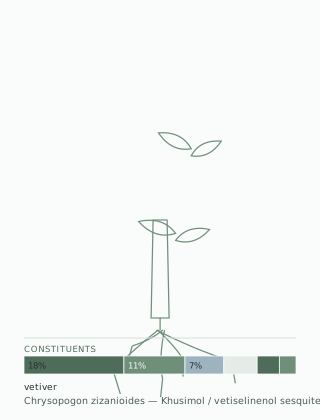
- Khusimol 18%
- Vetiselinenol 11%
- Vetivenic acid 7%
- beta-Vetivenene 6%
- Khusimene 4%
- alpha-Vetivone 3%
Storage & oxidation
A root oil of sesquiterpene alcohols and acids in a very heavy matrix. It does not form hydroperoxides and barely resinifies; five years is straightforward and older material is valued. Vetiver is also the most tenacious oil on this site — a 1% blend will scent clothing through several washes.
Rotation & substitution
Vetiver is used as a fixed base and rarely rotated, which is reasonable given its low reactivity. If you want a change of base note in the same slot, atlas cedarwood or patchouli are the natural alternates — but they are all sesquiterpene-dense, so if you are rotating for exposure reasons rather than scent, alternate with lavender instead.
Adjacent materials
Patchouli (Pogostemon cablin) · monograph
The other heavy