Single-oil monograph
Patchouli (Pogostemon cablin)
- Phototoxic No phototoxicity
- Pregnancy Caution
- Pets Caution
Published 2026-09-24 · adult ceiling 3% · shelf life 60 months
Patchouli is dried, fermented and then distilled, and that process — not any single molecule — is what produces the smell people either love or cannot tolerate. Chemically it is the most benign base note on this site: 32% patchoulol, no monoterpene hydroperoxides, a sixty-month shelf life and a 3% ceiling. The practical problems are staining and persistence, not toxicity.
Safe dilution matrix
Rows are the concentration, columns are the audience. Each cell carries two lines: drops per 10 ml of carrier oil, and whether this site advises that combination. Figures come from 1 ml = 20 drops, and the bold row is the ceiling for this oil.
| Dilution | Per 30 ml | Adult | Child 6+ | Pregnancy | Pets |
|---|---|---|---|---|---|
| 0.5% | 3 | 1 drops ✓ advised | 1 drops ✓ advised | 1 drops ✓ advised | 1 drops ✓ advised |
| 1% | 6 | 2 drops ✓ advised | 2 drops ✓ advised | 2 drops ✓ advised | 2 drops ✗ not advised |
| 2% | 12 | 4 drops ✓ advised | 4 drops ✓ advised | 4 drops ✗ not advised | 4 drops ✗ not advised |
| 3% | 18 | 6 drops ✓ advised | 6 drops ✗ not advised | 6 drops ✗ not advised | 6 drops ✗ not advised |
What each concentration is normally for: 0.5% — Facial blends, sensitive or broken skin, children 6-15, first patch test · 1% — Everyday adult body and massage blends, daily leave-on use · 2% — Short-term localised adult use, 7 to 10 days then re-assess · 3% — Adult ceiling for robust oils, small area, short course only
Contraindications & handling
✓ no restriction · ! caution · ✗ avoid. An avoid row means choosing a different material, not lowering the concentration.
- ! Pregnancy & breastfeeding — caution
- ✓ Children under 16 — ok
- ! Households with pets — caution
- ✓ Epilepsy — ok
- ✓ Antihypertensive medication — ok
- ! Anticoagulant medication — caution
Four-step skin patch test
- Dilute 1 drop in 5 ml of carrier oil (1%). Patchouli is dark and staining — test on skin you are willing to mark.
- Apply 2 drops to the inner forearm.
- Cover for 24 hours.
- Read at 24 and 48 hours. Patchouli sensitises rarely; when it does, it is usually a very dark, persistent reaction.
Botanical record
- Family
- Lamiaceae · Lamiaceae
- Botanical part
- leaf
- Extraction
- steam-distillation (dried, fermented leaf)
- Origin
- Indonesia (Sumatra), India, China
- Chemotype
- Patchoulol / alpha-bulnesene sesquiterpene type
- Phototoxicity
- No phototoxicity
- Shelf life
- 60 months
Principal constituents
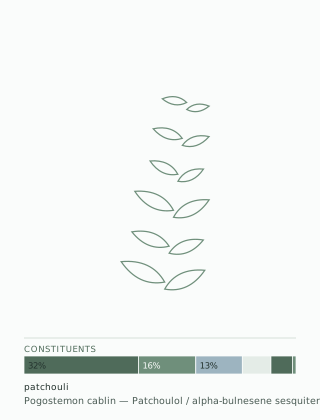
- Patchoulol 32%
- alpha-Bulnesene 16%
- alpha-Guaiene 13%
- Seychellene 8%
- beta-Patchoulene 6%
- Norpatchoulenol 1%
Storage & oxidation
Patchouli is a sesquiterpene oil with almost no monoterpenes, and it does not form hydroperoxides in any meaningful quantity. More than any other oil here it improves with age — the harsh, musty top note of a new bottle softens over three to five years into the rounder material the fragrance industry pays a premium for. Sixty months is conservative.
Rotation & substitution
Patchouli is a base note that people treat as a signature rather than a variable, and its low hydroperoxide risk makes that defensible. If you use it daily, alternate with cedarwood or vetiver rather than another sesquiterpene-dense oil, and be aware that it will scent clothing and bedding for weeks.
Adjacent materials
Vetiver (Chrysopogon zizanioides) · monograph
Also a heavy