Single-oil monograph
Sandalwood (Santalum album)
- Phototoxic No phototoxicity
- Pregnancy Caution
- Pets Caution
Published 2026-10-06 · adult ceiling 3% · shelf life 60 months
Indian sandalwood is the most counterfeited oil on this site. Santalum album is a hemi-parasitic tree that takes 15 to 30 years to produce heartwood worth distilling, and the trade in it has been regulated for decades. Most "sandalwood" sold cheaply is Amyris, a different species with a different principal constituent. This monograph covers the 3% ceiling, the sourcing problem and the honest position on the skincare claims.
Safe dilution matrix
Rows are the concentration, columns are the audience. Each cell carries two lines: drops per 10 ml of carrier oil, and whether this site advises that combination. Figures come from 1 ml = 20 drops, and the bold row is the ceiling for this oil.
| Dilution | Per 30 ml | Adult | Child 6+ | Pregnancy | Pets |
|---|---|---|---|---|---|
| 0.5% | 3 | 1 drops ✓ advised | 1 drops ✓ advised | 1 drops ✓ advised | 1 drops ✓ advised |
| 1% | 6 | 2 drops ✓ advised | 2 drops ✓ advised | 2 drops ✓ advised | 2 drops ✓ advised |
| 2% | 12 | 4 drops ✓ advised | 4 drops ✓ advised | 4 drops ✗ not advised | 4 drops ✗ not advised |
| 3% | 18 | 6 drops ✓ advised | 6 drops ✗ not advised | 6 drops ✗ not advised | 6 drops ✗ not advised |
What each concentration is normally for: 0.5% — Facial blends, sensitive or broken skin, children 6-15, first patch test · 1% — Everyday adult body and massage blends, daily leave-on use · 2% — Short-term localised adult use, 7 to 10 days then re-assess · 3% — Adult ceiling for robust oils, small area, short course only
Contraindications & handling
✓ no restriction · ! caution · ✗ avoid. An avoid row means choosing a different material, not lowering the concentration.
- ! Pregnancy & breastfeeding — caution
- ✓ Children under 16 — ok
- ! Households with pets — caution
- ✓ Epilepsy — ok
- ✓ Antihypertensive medication — ok
- ✓ Anticoagulant medication — ok
Four-step skin patch test
- Dilute 1 drop in 5 ml of carrier oil (1%). Sandalwood is thick and slow to drop.
- Apply 2 drops to the inner forearm.
- Cover for 24 hours.
- Read at 24 and 48 hours. Sandalwood sensitises very rarely; a reaction more often points to an adulterant than to santalol itself.
Botanical record
- Family
- Santalaceae · Santalaceae
- Botanical part
- heartwood and root
- Extraction
- steam-distillation (aged wood, 15-30 years)
- Origin
- India (Karnataka, Tamil Nadu), Australia (plantation)
- Chemotype
- alpha-Santalol / beta-santalol sesquiterpene alcohol type
- Phototoxicity
- No phototoxicity
- Shelf life
- 60 months
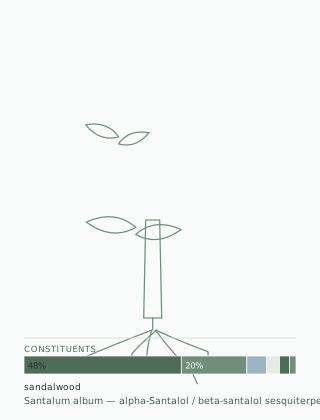
Principal constituents
- alpha-Santalol 48%
- beta-Santalol 20%
- alpha-Santalene 6%
- epi-beta-Santalol 4%
- alpha-Bergamotene 3%
- beta-Santalene 2%
Storage & oxidation
Santalol is a sesquiterpene alcohol in a heavy, resinous matrix with almost no monoterpene content, so sandalwood neither oxidises quickly nor resins to unusability. Old sandalwood thickens and darkens and smells better, not worse. A 60-month figure is conservative; a well-kept bottle is good for a decade.
Rotation & substitution
Sandalwood is a fixed base note and practically nobody rotates it, which is fine: it is one of the lowest-risk oils on this site, with a 1% row that includes pregnancy and pets. The real consideration is cost and sourcing rather than safety — rotate it with vetiver or cedarwood if you want a cheaper heavy base in the same slot.
Adjacent materials
Australian sandalwood (Santalum spicatum)
A different species
Amyris (Amyris balsamifera)
Sold as "West Indian sandalwood" and frequently used to extend real sandalwood. Valerianol-dominant