Single-oil monograph
Clove bud (Syzygium aromaticum)
- Phototoxic No phototoxicity
- Pregnancy Avoid
- Pets Avoid
Published 2026-10-02 · adult ceiling 1% · shelf life 36 months
Clove is 78% eugenol, and this site prints a 1% ceiling — half the figure used for ordinary oils — with an avoid row for pregnancy, children, pets and anyone on anticoagulant medication. It is also the oil most commonly used as a "spot" treatment for toothache, which is precisely how the reported burns and contact stomatitis happen.
Safe dilution matrix
Rows are the concentration, columns are the audience. Each cell carries two lines: drops per 10 ml of carrier oil, and whether this site advises that combination. Figures come from 1 ml = 20 drops, and the bold row is the ceiling for this oil.
| Dilution | Per 30 ml | Adult | Child 6+ | Pregnancy | Pets |
|---|---|---|---|---|---|
| 0.5% | 3 | 1 drops ✓ advised | 1 drops ✗ not advised | 1 drops ✗ not advised | 1 drops ✗ not advised |
| 1% | 6 | 2 drops ✓ advised | 2 drops ✗ not advised | 2 drops ✗ not advised | 2 drops ✗ not advised |
What each concentration is normally for: 0.5% — Facial blends, sensitive or broken skin, children 6-15, first patch test · 1% — Everyday adult body and massage blends, daily leave-on use · 2% — Short-term localised adult use, 7 to 10 days then re-assess · 3% — Adult ceiling for robust oils, small area, short course only
Contraindications & handling
✓ no restriction · ! caution · ✗ avoid. An avoid row means choosing a different material, not lowering the concentration.
- ✗ Pregnancy & breastfeeding — avoid
- ✗ Children under 16 — avoid
- ✗ Households with pets — avoid
- ✓ Epilepsy — ok
- ! Antihypertensive medication — caution
- ✗ Anticoagulant medication — avoid
Four-step skin patch test
- Dilute 1 drop in 10 ml of carrier oil (0.5%, not 1%) — clove is one of the two strongest irritants on this site.
- Apply 1 drop of that blend to the inner forearm. Do not cover a large area.
- Cover for 24 hours.
- Read at 24 and 48 hours. Any burning within the first hour means wash it off with carrier oil and stop.
Botanical record
- Family
- Myrtaceae · Myrtaceae
- Botanical part
- flower bud
- Extraction
- steam-distillation
- Origin
- Madagascar, Indonesia (Maluku), Sri Lanka
- Chemotype
- Eugenol-dominant
- Phototoxicity
- No phototoxicity
- Shelf life
- 36 months
Principal constituents
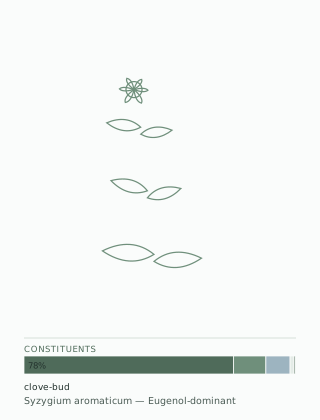
- Eugenol 78%
- Eugenyl acetate 12%
- beta-Caryophyllene 9%
- alpha-Humulene 1.5%
- Caryophyllene oxide 0.5%
- Methyl salicylate 0.2%
Storage & oxidation
Eugenol is a phenol and phenols are comparatively stable; the caryophyllene fraction oxidises slowly. Clove bud keeps three years without difficulty, and the reason this bottle should still be small is not shelf life — it is that at a 1% ceiling almost nobody uses 10 ml before it ages out of relevance.
Rotation & substitution
Clove, cinnamon bark and cinnamon leaf all lean on eugenol or cinnamaldehyde, and cross-reactivity between them is well documented. Rotating among them is not a rotation. If you use clove, do not use cinnamon in the same period, and leave at least a fortnight between finishing one and starting the other.
Adjacent materials
Clove leaf
82-88% eugenol
Allspice (Pimenta dioica)
Also eugenol-dominant (60-80%) with a warmer