Single-oil monograph
Damask rose (Rosa damascena)
- Phototoxic No phototoxicity
- Pregnancy Caution
- Pets Caution
Published 2026-11-03 · adult ceiling 2% · shelf life 36 months
Rose otto is the reference luxury oil: roughly 4,000 kg of hand-picked petals to produce a single kilogram, which is why it is sold in 2 ml and 5 ml bottles. This page covers what the price actually buys, why "rose oil" at a low price is never rose, and the one genuine safety point — eugenol, and a 2% ceiling that almost nobody will reach anyway.
Safe dilution matrix
Rows are the concentration, columns are the audience. Each cell carries two lines: drops per 10 ml of carrier oil, and whether this site advises that combination. Figures come from 1 ml = 20 drops, and the bold row is the ceiling for this oil.
| Dilution | Per 30 ml | Adult | Child 6+ | Pregnancy | Pets |
|---|---|---|---|---|---|
| 0.5% | 3 | 1 drops ✓ advised | 1 drops ✓ advised | 1 drops ✗ not advised | 1 drops ✗ not advised |
| 1% | 6 | 2 drops ✓ advised | 2 drops ✗ not advised | 2 drops ✗ not advised | 2 drops ✗ not advised |
| 2% | 12 | 4 drops ✓ advised | 4 drops ✗ not advised | 4 drops ✗ not advised | 4 drops ✗ not advised |
What each concentration is normally for: 0.5% — Facial blends, sensitive or broken skin, children 6-15, first patch test · 1% — Everyday adult body and massage blends, daily leave-on use · 2% — Short-term localised adult use, 7 to 10 days then re-assess · 3% — Adult ceiling for robust oils, small area, short course only
Contraindications & handling
✓ no restriction · ! caution · ✗ avoid. An avoid row means choosing a different material, not lowering the concentration.
- ! Pregnancy & breastfeeding — caution
- ! Children under 16 — caution
- ! Households with pets — caution
- ✓ Epilepsy — ok
- ✓ Antihypertensive medication — ok
- ✓ Anticoagulant medication — ok
Four-step skin patch test
- Dilute 1 drop in 5 ml of carrier oil (1%). Given the price, this is 10 ml of waste at most.
- Apply 2 drops to the inner forearm.
- Cover for 24 hours.
- Read at 24 and 48 hours. Rose contains eugenol, a known sensitiser, so a positive is possible even though the oil is otherwise gentle.
Botanical record
- Family
- Rosaceae · Rosaceae
- Botanical part
- flower
- Extraction
- steam-distillation (otto); solvent extraction gives absolute
- Origin
- Bulgaria (Rose Valley), Turkey (Isparta), Iran, Morocco
- Chemotype
- Citronellol / geraniol type with rose oxides
- Phototoxicity
- No phototoxicity
- Shelf life
- 36 months
Principal constituents
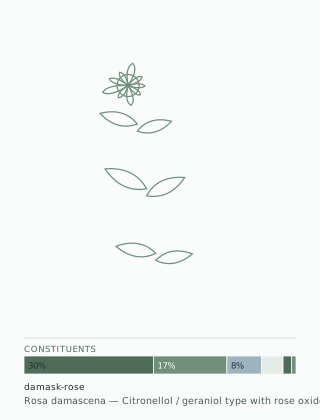
- Citronellol 30%
- Geraniol 17%
- Nerol 8%
- Citronellyl acetate 5%
- Rose oxide 2%
- Eugenol 1%
Storage & oxidation
Rose otto is exceptionally stable for a flower oil: the citronellol and geraniol fraction is slow to oxidise and the eugenol fraction acts as a natural antioxidant. Three years is realistic. It also thickens and can crystallise slightly in a cold room, which is normal and reverses on warming — do not read it as spoilage.
Rotation & substitution
Rose belongs to the geraniol-citronellol group with geranium and palmarosa, and rotating within that group is one exposure under three names. Given the cost, most people use rose at 0.5% as a finishing note rather than as a workhorse, which is its own form of rotation.
Adjacent materials
Rose absolute (solvent-extracted)
A different product from the same flower — darker