Single-oil monograph
Neroli (Citrus aurantium flower)
- Phototoxic No phototoxicity
- Pregnancy Caution
- Pets Caution
Published 2026-09-30 · adult ceiling 3% · shelf life 24 months
Neroli is the flower of the bitter orange tree, and it is the only oil on this site that is both high in linalool and genuinely expensive — a combination that produces a specific failure pattern, where a bottle bought five years ago is still being used because "it cost that much". This monograph covers the 3% ceiling, the oxidation economy, and the honest position on the anxiety claims.
Safe dilution matrix
Rows are the concentration, columns are the audience. Each cell carries two lines: drops per 10 ml of carrier oil, and whether this site advises that combination. Figures come from 1 ml = 20 drops, and the bold row is the ceiling for this oil.
| Dilution | Per 30 ml | Adult | Child 6+ | Pregnancy | Pets |
|---|---|---|---|---|---|
| 0.5% | 3 | 1 drops ✓ advised | 1 drops ✓ advised | 1 drops ✓ advised | 1 drops ✗ not advised |
| 1% | 6 | 2 drops ✓ advised | 2 drops ✓ advised | 2 drops ✗ not advised | 2 drops ✗ not advised |
| 2% | 12 | 4 drops ✓ advised | 4 drops ✗ not advised | 4 drops ✗ not advised | 4 drops ✗ not advised |
| 3% | 18 | 6 drops ✓ advised | 6 drops ✗ not advised | 6 drops ✗ not advised | 6 drops ✗ not advised |
What each concentration is normally for: 0.5% — Facial blends, sensitive or broken skin, children 6-15, first patch test · 1% — Everyday adult body and massage blends, daily leave-on use · 2% — Short-term localised adult use, 7 to 10 days then re-assess · 3% — Adult ceiling for robust oils, small area, short course only
Contraindications & handling
✓ no restriction · ! caution · ✗ avoid. An avoid row means choosing a different material, not lowering the concentration.
- ! Pregnancy & breastfeeding — caution
- ! Children under 16 — caution
- ! Households with pets — caution
- ✓ Epilepsy — ok
- ✓ Antihypertensive medication — ok
- ✓ Anticoagulant medication — ok
Four-step skin patch test
- Dilute 1 drop in 5 ml of carrier oil (1%).
- Apply 2 drops to the inner forearm.
- Cover for 24 hours.
- Read at 24 and 48 hours. Because neroli oxidises quickly, patch test every bottle rather than trusting a previous brand.
Botanical record
- Family
- Rutaceae · Rutaceae
- Botanical part
- flower
- Extraction
- steam-distillation
- Origin
- Tunisia, Morocco, Egypt, Italy
- Chemotype
- Linalool / linalyl acetate / anthranilate ester type
- Phototoxicity
- No phototoxicity
- Shelf life
- 24 months
Principal constituents
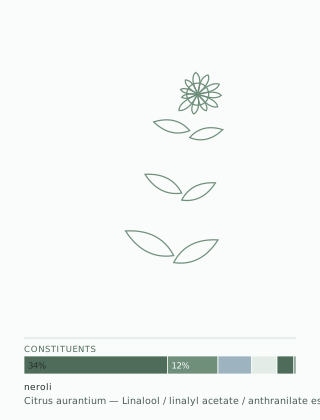
- Linalool 34%
- Linalyl acetate 12%
- Methyl anthranilate 8%
- Nerolidol 6%
- Geraniol 4%
- Indole 0.5%
Storage & oxidation
Neroli is 34% linalool, which is the highest linalool fraction of any oil on this site and therefore one of the faster-deteriorating flowers. Linalool hydroperoxide forms inside a partly empty bottle and is a stronger sensitiser than linalool itself. Twenty-four months is the outside; because neroli is expensive, people keep bottles far longer than that, which is exactly the wrong economy.
Rotation & substitution
Neroli carries a very high price per millilitre, which naturally limits its use, and that is a safety advantage rather than a problem. Rotate it with bergamot FCF, petitgrain or geranium — all floral-citrus in character, none of them the same molecule family as neroli's linalool-dominant profile.
Adjacent materials
Petitgrain (Citrus aurantium leaf)
Same plant
Neroli
Tunisian material is the reference for the honeyed top note; Egyptian is more orange-blossom and cheaper. Both are Citrus aurantium flower oil and both are safe at these figures.