Single-oil monograph
Palmarosa (Cymbopogon martinii)
- Phototoxic No phototoxicity
- Pregnancy Caution
- Pets Caution
Published 2026-10-30 · adult ceiling 3% · shelf life 30 months
Palmarosa is 75% geraniol, which makes it the cheapest convincing rose note available and the standard commercial extender for rose otto. It is a grass, not a flower, and it is one of the better-tolerated oils on this site at a 3% ceiling — with the caveat that geraniol is one of the fragrance allergens your skin is most likely to have met before.
Safe dilution matrix
Rows are the concentration, columns are the audience. Each cell carries two lines: drops per 10 ml of carrier oil, and whether this site advises that combination. Figures come from 1 ml = 20 drops, and the bold row is the ceiling for this oil.
| Dilution | Per 30 ml | Adult | Child 6+ | Pregnancy | Pets |
|---|---|---|---|---|---|
| 0.5% | 3 | 1 drops ✓ advised | 1 drops ✓ advised | 1 drops ✓ advised | 1 drops ✗ not advised |
| 1% | 6 | 2 drops ✓ advised | 2 drops ✓ advised | 2 drops ✗ not advised | 2 drops ✗ not advised |
| 2% | 12 | 4 drops ✓ advised | 4 drops ✗ not advised | 4 drops ✗ not advised | 4 drops ✗ not advised |
| 3% | 18 | 6 drops ✓ advised | 6 drops ✗ not advised | 6 drops ✗ not advised | 6 drops ✗ not advised |
What each concentration is normally for: 0.5% — Facial blends, sensitive or broken skin, children 6-15, first patch test · 1% — Everyday adult body and massage blends, daily leave-on use · 2% — Short-term localised adult use, 7 to 10 days then re-assess · 3% — Adult ceiling for robust oils, small area, short course only
Contraindications & handling
✓ no restriction · ! caution · ✗ avoid. An avoid row means choosing a different material, not lowering the concentration.
- ! Pregnancy & breastfeeding — caution
- ✓ Children under 16 — ok
- ! Households with pets — caution
- ✓ Epilepsy — ok
- ✓ Antihypertensive medication — ok
- ✓ Anticoagulant medication — ok
Four-step skin patch test
- Dilute 1 drop in 5 ml of carrier oil (1%).
- Apply 2 drops to the inner forearm.
- Cover for 24 hours.
- Read at 24 and 48 hours. Geraniol is a recognised fragrance sensitiser in the general population, so a positive is not rare and is worth taking seriously.
Botanical record
- Family
- Poaceae · Poaceae
- Botanical part
- leaf (flowering grass)
- Extraction
- steam-distillation
- Origin
- India, Nepal, Madagascar
- Chemotype
- Geraniol-dominant; the sofia type is the high-grade one
- Phototoxicity
- No phototoxicity
- Shelf life
- 30 months
Principal constituents
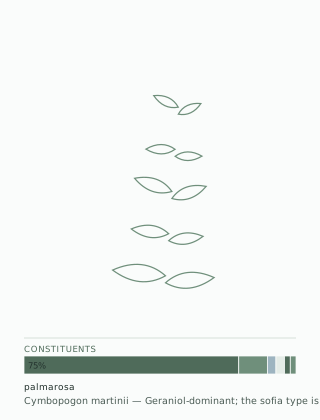
- Geraniol 75%
- Geranyl acetate 10%
- Linalool 3%
- beta-Caryophyllene 3%
- Geranial 2%
- Limonene 2%
Storage & oxidation
Geraniol behaves like linalool: it is a monoterpene alcohol that is well tolerated while fresh and forms geranial and peroxide species as it ages. Thirty months is achievable in a full, cool, dark bottle and unrealistic in a half-empty one on a windowsill. Palmarosa is cheap enough that 30 ml is the correct size rather than 100 ml.
Rotation & substitution
Palmarosa, geranium and rose all lean on geraniol and citronellol, and rotating among the three is one exposure with three labels. Rotate palmarosa with a wood or a citrus instead, and if you have reacted to a scented cosmetic before, treat the whole geraniol group as one.
Adjacent materials
Geranium (Pelargonium graveolens) · monograph
Similar geraniol-led rose profile but with citronellol and a minty-rose edge; the two are frequently substituted for each other commercially. Reasonable swap within the same exposure group.