Single-oil monograph
Roman chamomile (Chamaemelum nobile)
- Phototoxic No phototoxicity
- Pregnancy Caution
- Pets Caution
Published 2026-09-01 · adult ceiling 3% · shelf life 24 months
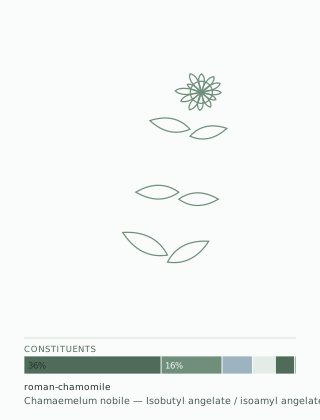
The gentlest reputation on this site, and the highest price per millilitre. Roman chamomile is an ester oil — 52% angelate esters by the profile above — with almost none of the ketones and phenols that cause trouble elsewhere. It is also the oil most often confused with German chamomile, which is a different plant with different chemistry.
Safe dilution matrix
Rows are the concentration, columns are the audience. Each cell carries two lines: drops per 10 ml of carrier oil, and whether this site advises that combination. Figures come from 1 ml = 20 drops, and the bold row is the ceiling for this oil.
| Dilution | Per 30 ml | Adult | Child 6+ | Pregnancy | Pets |
|---|---|---|---|---|---|
| 0.5% | 3 | 1 drops ✓ advised | 1 drops ✓ advised | 1 drops ✓ advised | 1 drops ✓ advised |
| 1% | 6 | 2 drops ✓ advised | 2 drops ✓ advised | 2 drops ✓ advised | 2 drops ✗ not advised |
| 2% | 12 | 4 drops ✓ advised | 4 drops ✓ advised | 4 drops ✗ not advised | 4 drops ✗ not advised |
| 3% | 18 | 6 drops ✓ advised | 6 drops ✗ not advised | 6 drops ✗ not advised | 6 drops ✗ not advised |
What each concentration is normally for: 0.5% — Facial blends, sensitive or broken skin, children 6-15, first patch test · 1% — Everyday adult body and massage blends, daily leave-on use · 2% — Short-term localised adult use, 7 to 10 days then re-assess · 3% — Adult ceiling for robust oils, small area, short course only
Contraindications & handling
✓ no restriction · ! caution · ✗ avoid. An avoid row means choosing a different material, not lowering the concentration.
- ! Pregnancy & breastfeeding — caution
- ✓ Children under 16 — ok
- ! Households with pets — caution
- ✓ Epilepsy — ok
- ✓ Antihypertensive medication — ok
- ! Anticoagulant medication — caution
Four-step skin patch test
- Dilute 1 drop in 5 ml of carrier oil (1%).
- Apply 2 drops to the inner forearm.
- Cover for 24 hours.
- Read at 24 and 48 hours. If you react to other Asteraceae plants — ragweed, mugwort, chrysanthemum — treat a reaction here as expected rather than surprising.
Botanical record
- Family
- Asteraceae · Asteraceae
- Botanical part
- flower
- Extraction
- steam-distillation
- Origin
- England, France, Germany, Hungary
- Chemotype
- Isobutyl angelate / isoamyl angelate ester type
- Phototoxicity
- No phototoxicity
- Shelf life
- 24 months
Principal constituents
- Isobutyl angelate 36%
- Isoamyl angelate 16%
- Methallyl angelate 8%
- Pinocarvone 6%
- alpha-Pinene 5%
- Chamazulene 0.4%
Storage & oxidation
Roman chamomile's principal constituents are angelate esters, which are unusually resistant to oxidation for a flower oil; the 24-month figure is conservative. The chamazulene that gives the oil its blue-green colour is an artefact of distillation, is present below 1%, and darkens over time without signalling spoilage.
Rotation & substitution
Roman chamomile is expensive, so most people use it sparingly and rarely need a rotation plan. If you use it daily, alternate with lavender or sweet orange. Avoid rotating it with German chamomile or yarrow — same family, overlapping sesquiterpene and lactone profile, and a shared cross-reactivity risk for Asteraceae-sensitive users.
Adjacent materials
German chamomile (Matricaria chamomilla)
Bisabolol and chamazulene dominant (chamazulene up to 15%)
Roman chamomile
Often Ormenis mixta rather than Chamaemelum nobile