Single-oil monograph
Sweet orange (Citrus sinensis)
- Phototoxic No phototoxicity
- Pregnancy Caution
- Pets Caution
Published 2026-08-24 · adult ceiling 3% · shelf life 18 months
Sweet orange is the cheapest, the safest-looking and the most frequently spoiled oil on a home shelf. It is roughly 94% limonene, it is not phototoxic, and it is the oil most likely to be in a bottle that has been open for three years. This monograph covers the 18-month shelf life, the oxidation chemistry, and why the "children are fine with it" reputation needs a caveat.
Safe dilution matrix
Rows are the concentration, columns are the audience. Each cell carries two lines: drops per 10 ml of carrier oil, and whether this site advises that combination. Figures come from 1 ml = 20 drops, and the bold row is the ceiling for this oil.
| Dilution | Per 30 ml | Adult | Child 6+ | Pregnancy | Pets |
|---|---|---|---|---|---|
| 0.5% | 3 | 1 drops ✓ advised | 1 drops ✓ advised | 1 drops ✓ advised | 1 drops ✓ advised |
| 1% | 6 | 2 drops ✓ advised | 2 drops ✓ advised | 2 drops ✓ advised | 2 drops ✗ not advised |
| 2% | 12 | 4 drops ✓ advised | 4 drops ✗ not advised | 4 drops ✗ not advised | 4 drops ✗ not advised |
| 3% | 18 | 6 drops ✓ advised | 6 drops ✗ not advised | 6 drops ✗ not advised | 6 drops ✗ not advised |
What each concentration is normally for: 0.5% — Facial blends, sensitive or broken skin, children 6-15, first patch test · 1% — Everyday adult body and massage blends, daily leave-on use · 2% — Short-term localised adult use, 7 to 10 days then re-assess · 3% — Adult ceiling for robust oils, small area, short course only
Contraindications & handling
✓ no restriction · ! caution · ✗ avoid. An avoid row means choosing a different material, not lowering the concentration.
- ! Pregnancy & breastfeeding — caution
- ✓ Children under 16 — ok
- ! Households with pets — caution
- ✓ Epilepsy — ok
- ✓ Antihypertensive medication — ok
- ✓ Anticoagulant medication — ok
Four-step skin patch test
- Dilute 1 drop of sweet orange in 5 ml of carrier oil (1%).
- Apply 2 drops to the inner forearm and let it dry.
- Cover for 24 hours, keeping the site out of sunlight.
- Read at 24 and 48 hours. Because the main risk here is an oxidised bottle, patch test each new bottle rather than each new brand.
Botanical record
- Family
- Rutaceae · Rutaceae
- Botanical part
- peel
- Extraction
- cold-pressing
- Origin
- Brazil, Spain, Italy, United States (Florida)
- Chemotype
- Limonene-dominant; no meaningful chemotype variation
- Phototoxicity
- No phototoxicity
- Shelf life
- 18 months
Principal constituents
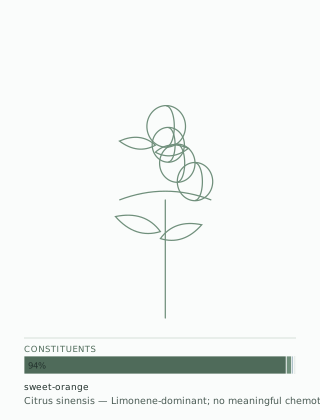
- Limonene 94%
- Myrcene 2%
- alpha-Pinene 0.6%
- Sabinene 0.4%
- Linalool 0.3%
- Decanal 0.2%
Storage & oxidation
At 94% limonene this is the fastest-oxidising oil on the site. Limonene converts to limonene hydroperoxide, which is a potent sensitiser and is formed in a partly empty bottle within months at room temperature. Sweet orange is a 10 ml purchase with an 18-month life, kept in the fridge if you can, and thrown away the moment the smell turns from fresh peel to turpentine.
Rotation & substitution
Sweet orange is the most-used oil in beginner blends and the most commonly left open. Rotate it with a non-citrus oil — atlas cedarwood, frankincense, ginger — after two to three weeks, and never let it be the only oil in a daily blend, because daily limonene exposure from a degrading bottle is how a pleasant smell becomes a permanent allergy.
Adjacent materials
Mandarin (Citrus reticulata)
Lower limonene
Sweet orange
Steam-distilled orange has most of the non-volatile fraction removed and oxidises more slowly