Single-oil monograph
Ylang-ylang (Cananga odorata, grade III)
- Phototoxic No phototoxicity
- Pregnancy Caution
- Pets Caution
Published 2026-09-15 · adult ceiling 2% · shelf life 24 months
Ylang-ylang is the only oil on this site sold by grade rather than by species, because it is a fractional distillate: the first fraction is grade I, the last is grade III, and "complete" is the whole run. The grades differ in price by a factor of five and in composition by enough to matter. This monograph is written for grade III, the one most commonly bought.
Safe dilution matrix
Rows are the concentration, columns are the audience. Each cell carries two lines: drops per 10 ml of carrier oil, and whether this site advises that combination. Figures come from 1 ml = 20 drops, and the bold row is the ceiling for this oil.
| Dilution | Per 30 ml | Adult | Child 6+ | Pregnancy | Pets |
|---|---|---|---|---|---|
| 0.5% | 3 | 1 drops ✓ advised | 1 drops ✓ advised | 1 drops ✓ advised | 1 drops ✗ not advised |
| 1% | 6 | 2 drops ✓ advised | 2 drops ✓ advised | 2 drops ✗ not advised | 2 drops ✗ not advised |
| 2% | 12 | 4 drops ✓ advised | 4 drops ✗ not advised | 4 drops ✗ not advised | 4 drops ✗ not advised |
What each concentration is normally for: 0.5% — Facial blends, sensitive or broken skin, children 6-15, first patch test · 1% — Everyday adult body and massage blends, daily leave-on use · 2% — Short-term localised adult use, 7 to 10 days then re-assess · 3% — Adult ceiling for robust oils, small area, short course only
Contraindications & handling
✓ no restriction · ! caution · ✗ avoid. An avoid row means choosing a different material, not lowering the concentration.
- ! Pregnancy & breastfeeding — caution
- ! Children under 16 — caution
- ! Households with pets — caution
- ✓ Epilepsy — ok
- ! Antihypertensive medication — caution
- ✓ Anticoagulant medication — ok
Four-step skin patch test
- Dilute 1 drop in 5 ml of carrier oil (1%).
- Apply 2 drops to the inner forearm.
- Cover for 24 hours.
- Read at 24 and 48 hours. Ylang-ylang is one of the more frequently reported fragrance sensitisers, so treat the 48-hour read as the decisive one.
Botanical record
- Family
- Annonaceae · Annonaceae
- Botanical part
- flower
- Extraction
- steam-distillation (fractional)
- Origin
- Madagascar, Comoros, Philippines
- Chemotype
- Benzyl acetate / linalool / methyl benzoate, graded I to III
- Phototoxicity
- No phototoxicity
- Shelf life
- 24 months
Principal constituents
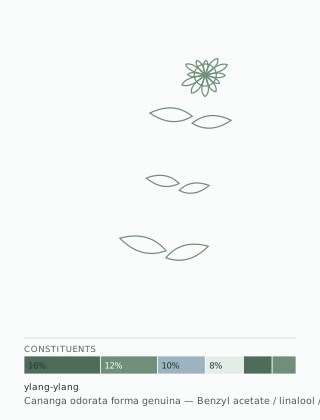
- Linalool 16%
- Geranyl acetate 12%
- Benzyl acetate 10%
- Methyl benzoate 8%
- para-Cresyl methyl ether 6%
- Benzyl salicylate 5%
Storage & oxidation
A complex ester oil, and the esters are the slowest-oxidising part of it. Linalool at 16% is the fraction that turns, so the practical life is 24 months. Ylang-ylang darkens as it ages, from pale yellow to amber-brown; the colour change alone is not a defect, but a smell that has gone from floral to flat and waxy is.
Rotation & substitution
Ylang-ylang at 2% is strong enough that most people use it intermittently by choice. Rotate it with a lighter floral or a citrus — neroli, geranium, sweet orange — and keep it out of blends used daily for months, because benzyl salicylate and para-cresyl methyl ether are both recognised sensitising or irritating components.
Adjacent materials
Ylang-ylang I (first fraction)
The first fraction off the still — the sharpest