Single-oil monograph
Atlas cedarwood (Cedrus atlantica)
- Phototoxic No phototoxicity
- Pregnancy Caution
- Pets Caution
Published 2026-09-03 · adult ceiling 3% · shelf life 60 months
Cedarwood is the workhorse base note: cheap, stable, hard to over-dose in practice, and almost never the reason a blend goes wrong. It is also the oil where the largest number of "cedarwood" bottles are not cedarwood at all — most of the world's supply is Juniperus virginiana or Juniperus mexicana, two junipers sold under the same word. This monograph covers the distinction, the 60-month life and the sedation caveat.
Safe dilution matrix
Rows are the concentration, columns are the audience. Each cell carries two lines: drops per 10 ml of carrier oil, and whether this site advises that combination. Figures come from 1 ml = 20 drops, and the bold row is the ceiling for this oil.
| Dilution | Per 30 ml | Adult | Child 6+ | Pregnancy | Pets |
|---|---|---|---|---|---|
| 0.5% | 3 | 1 drops ✓ advised | 1 drops ✓ advised | 1 drops ✓ advised | 1 drops ✓ advised |
| 1% | 6 | 2 drops ✓ advised | 2 drops ✓ advised | 2 drops ✓ advised | 2 drops ✗ not advised |
| 2% | 12 | 4 drops ✓ advised | 4 drops ✓ advised | 4 drops ✗ not advised | 4 drops ✗ not advised |
| 3% | 18 | 6 drops ✓ advised | 6 drops ✗ not advised | 6 drops ✗ not advised | 6 drops ✗ not advised |
What each concentration is normally for: 0.5% — Facial blends, sensitive or broken skin, children 6-15, first patch test · 1% — Everyday adult body and massage blends, daily leave-on use · 2% — Short-term localised adult use, 7 to 10 days then re-assess · 3% — Adult ceiling for robust oils, small area, short course only
Contraindications & handling
✓ no restriction · ! caution · ✗ avoid. An avoid row means choosing a different material, not lowering the concentration.
- ! Pregnancy & breastfeeding — caution
- ✓ Children under 16 — ok
- ! Households with pets — caution
- ! Epilepsy — caution
- ✓ Antihypertensive medication — ok
- ✓ Anticoagulant medication — ok
Four-step skin patch test
- Dilute 1 drop in 5 ml of carrier oil (1%). Cedarwood is viscous; expect a slower drop.
- Apply 2 drops to the inner forearm.
- Cover for 24 hours.
- Read at 24 and 48 hours. Wood oils sensitise rarely; a reaction here usually means you are reacting to something else in the blend.
Botanical record
- Family
- Pinaceae · Pinaceae
- Botanical part
- wood
- Extraction
- steam-distillation
- Origin
- Morocco — Middle Atlas mountains
- Chemotype
- Himachalene / cedrol sesquiterpene profile
- Phototoxicity
- No phototoxicity
- Shelf life
- 60 months
Principal constituents
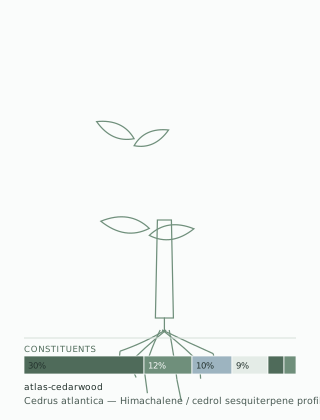
- beta-Himachalene 30%
- alpha-Himachalene 12%
- gamma-Himachalene 10%
- Cedrol 9%
- delta-Cadinene 4%
- Atlantone 3%
Storage & oxidation
A sesquiterpene-heavy wood oil with essentially no hydroperoxide-forming monoterpenes in the principal slots. It resins up rather than oxidising, keeps for five years or more, and is one of the few oils where an old bottle is not a safety question.
Rotation & substitution
Cedarwood is a fixed base note for many people rather than something they rotate. Because it is a sesquiterpene oil, continuous use is comparatively low-risk — but sesquiterpenes are still the family most often implicated in the (rare) cases of central-nervous-system effects attributed to cedarwood, so the traditional caution in epilepsy is carried here as caution rather than dismissed.
Adjacent materials
Virginian cedarwood (Juniperus virginiana)
A juniper
Texas cedarwood (Juniperus mexicana)
Higher cedrol