Single-oil monograph
Eucalyptus radiata
- Phototoxic No phototoxicity
- Pregnancy Caution
- Pets Avoid
Published 2026-09-12 · adult ceiling 3% · shelf life 24 months
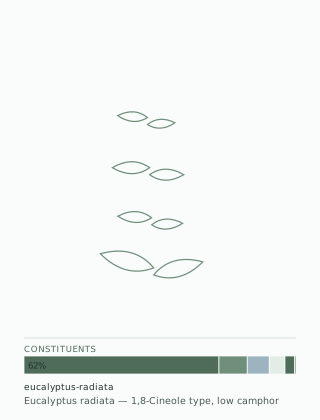
Of the eucalypts sold for the same purpose, Eucalyptus radiata is the one with the highest cineole and the lowest camphor — roughly 62% and 0.5% by the profile above. That makes it the mildest-smelling and the least harsh on skin, and it is still absolutely not an oil for infants. This monograph covers the under-six exclusion, the camphor confusion with E. globulus, and the petrolatum-rub comparison people actually make.
Safe dilution matrix
Rows are the concentration, columns are the audience. Each cell carries two lines: drops per 10 ml of carrier oil, and whether this site advises that combination. Figures come from 1 ml = 20 drops, and the bold row is the ceiling for this oil.
| Dilution | Per 30 ml | Adult | Child 6+ | Pregnancy | Pets |
|---|---|---|---|---|---|
| 0.5% | 3 | 1 drops ✓ advised | 1 drops ✓ advised | 1 drops ✗ not advised | 1 drops ✗ not advised |
| 1% | 6 | 2 drops ✓ advised | 2 drops ✓ advised | 2 drops ✗ not advised | 2 drops ✗ not advised |
| 2% | 12 | 4 drops ✓ advised | 4 drops ✗ not advised | 4 drops ✗ not advised | 4 drops ✗ not advised |
| 3% | 18 | 6 drops ✓ advised | 6 drops ✗ not advised | 6 drops ✗ not advised | 6 drops ✗ not advised |
What each concentration is normally for: 0.5% — Facial blends, sensitive or broken skin, children 6-15, first patch test · 1% — Everyday adult body and massage blends, daily leave-on use · 2% — Short-term localised adult use, 7 to 10 days then re-assess · 3% — Adult ceiling for robust oils, small area, short course only
Contraindications & handling
✓ no restriction · ! caution · ✗ avoid. An avoid row means choosing a different material, not lowering the concentration.
- ! Pregnancy & breastfeeding — caution
- ✗ Children under 16 — avoid
- ✗ Households with pets — avoid
- ! Epilepsy — caution
- ✓ Antihypertensive medication — ok
- ✓ Anticoagulant medication — ok
Four-step skin patch test
- Dilute 1 drop in 5 ml of carrier oil (1%).
- Apply 2 drops to the inner forearm.
- Cover for 24 hours.
- Read at 24 and 48 hours. Keep the patch site well away from the face while it is on — cineole vapour near the eyes and nose is the exposure you are trying to avoid.
Botanical record
- Family
- Myrtaceae · Myrtaceae
- Botanical part
- leaf
- Extraction
- steam-distillation
- Origin
- Australia — Victoria and New South Wales
- Chemotype
- 1,8-Cineole type, low camphor
- Phototoxicity
- No phototoxicity
- Shelf life
- 24 months
Principal constituents
- 1 62%
- alpha-Terpineol 9%
- Limonene 7%
- alpha-Pinene 5%
- Terpinen-4-ol 3%
- Camphor 0.5%
Storage & oxidation
Cineole and terpineol resist oxidation; the limonene fraction at 7% is the part that turns. Expect 24 months in a sealed amber bottle. The smell of an oxidised eucalyptus is not obviously wrong — it goes slightly flat and sweeter, which is why people use spoiled bottles for years without noticing.
Rotation & substitution
Do not rotate eucalyptus with rosemary, peppermint, niaouli or cajeput — all are cineole-forward and rotating between them stacks the same constituent on the same skin and the same airways. Rotate instead with a non-cineole oil entirely: lavender, tea tree or cedarwood.
Adjacent materials
Eucalyptus globulus · monograph
Cheaper and 1
Eucalyptus dives
A piperitone-dominant species with very little cineole. It is not a substitute at all — the whole point of using it is different.