Single-oil monograph
Lavender (Lavandula angustifolia)
- Phototoxic No phototoxicity
- Pregnancy Caution
- Pets Caution
Published 2026-08-17 · adult ceiling 3% · shelf life 36 months
The most-sold essential oil in the world and the one most often used undiluted. True lavender has a camphor content of about 1% and a linalyl acetate content near 38%, which puts it among the better-tolerated oils — provided the bottle is fresh. This monograph covers the dilution ceiling, the oxidation problem that most household bottles have, and the difference between true lavender and lavandin.
Safe dilution matrix
Rows are the concentration, columns are the audience. Each cell carries two lines: drops per 10 ml of carrier oil, and whether this site advises that combination. Figures come from 1 ml = 20 drops, and the bold row is the ceiling for this oil.
| Dilution | Per 30 ml | Adult | Child 6+ | Pregnancy | Pets |
|---|---|---|---|---|---|
| 0.5% | 3 | 1 drops ✓ advised | 1 drops ✓ advised | 1 drops ✓ advised | 1 drops ✓ advised |
| 1% | 6 | 2 drops ✓ advised | 2 drops ✓ advised | 2 drops ✗ not advised | 2 drops ✗ not advised |
| 2% | 12 | 4 drops ✓ advised | 4 drops ✗ not advised | 4 drops ✗ not advised | 4 drops ✗ not advised |
| 3% | 18 | 6 drops ✓ advised | 6 drops ✗ not advised | 6 drops ✗ not advised | 6 drops ✗ not advised |
What each concentration is normally for: 0.5% — Facial blends, sensitive or broken skin, children 6-15, first patch test · 1% — Everyday adult body and massage blends, daily leave-on use · 2% — Short-term localised adult use, 7 to 10 days then re-assess · 3% — Adult ceiling for robust oils, small area, short course only
Contraindications & handling
✓ no restriction · ! caution · ✗ avoid. An avoid row means choosing a different material, not lowering the concentration.
- ! Pregnancy & breastfeeding — caution
- ! Children under 16 — caution
- ! Households with pets — caution
- ✓ Epilepsy — ok
- ✓ Antihypertensive medication — ok
- ! Anticoagulant medication — caution
Four-step skin patch test
- Dilute 1 drop of lavender in 5 ml of jojoba or sunflower oil (1%).
- Apply 2 drops of that blend to the inner forearm, an area about the size of a coin.
- Cover with a plaster and leave it undisturbed for 24 hours, keeping the site dry.
- Read the site at 24 hours and again at 48 hours. Any redness, itch, heat or swelling means do not use it.
Botanical record
- Family
- Lamiaceae · Lamiaceae
- Botanical part
- flower
- Extraction
- steam-distillation
- Origin
- France — Provence, 800-1200 m
- Chemotype
- Linalool / linalyl acetate
- Phototoxicity
- No phototoxicity
- Shelf life
- 36 months
Principal constituents
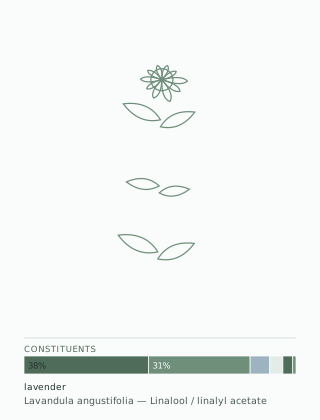
- Linalyl acetate 38%
- Linalool 31%
- cis-beta-Ocimene 6%
- Terpinen-4-ol 4%
- Lavandulyl acetate 3%
- Camphor 1%
Storage & oxidation
Linalool and linalyl acetate together are 69% of this oil by the profile above, and both oxidise into hydroperoxides in a partly empty bottle. The hydroperoxides are the actual sensitiser — a fresh bottle of lavender is one of the better-tolerated oils, an old one is not. Rebuy at 12 months if the bottle is below half, and discard on any acidic or vinegar-like note.
Rotation & substitution
Lavender is a defensible long-term base oil because its two dominant constituents are an ester and an alcohol rather than a phenol or an aldehyde. Still, rotate it out every second or third cycle with a chemically different oil — atlas cedarwood, frankincense or sweet orange — so that no single molecule family is applied continuously.
Adjacent materials
Lavandin (Lavandula x intermedia)
Cheaper and higher yielding
Clary sage (Salvia sclarea) · monograph
Shares the linalyl acetate character but carries sclareol and a documented caution around alcohol and driving. Not a like-for-like swap at bedtime.