Single-oil monograph
Lemon (Citrus limon, cold-pressed)
- Phototoxic Dose-dependent phototoxicity
- Pregnancy Caution
- Pets Avoid
Published 2026-09-09 · adult ceiling 2% · shelf life 18 months
Cold-pressed lemon is the oil people are most surprised to find restricted. It is cheap, it is in every supermarket, it is in every "natural cleaning" recipe — and it is phototoxic, it oxidises inside a year, and the citral fraction makes it a more frequent sensitiser than the smell suggests. This monograph explains which figures apply to expressed lemon and which apply to the distilled oil, because they are not the same material.
Safe dilution matrix
Rows are the concentration, columns are the audience. Each cell carries two lines: drops per 10 ml of carrier oil, and whether this site advises that combination. Figures come from 1 ml = 20 drops, and the bold row is the ceiling for this oil.
| Dilution | Per 30 ml | Adult | Child 6+ | Pregnancy | Pets |
|---|---|---|---|---|---|
| 0.5% | 3 | 1 drops ✓ advised | 1 drops ✓ advised | 1 drops ✗ not advised | 1 drops ✗ not advised |
| 1% | 6 | 2 drops ✓ advised | 2 drops ✓ advised | 2 drops ✗ not advised | 2 drops ✗ not advised |
| 2% | 12 | 4 drops ✓ advised | 4 drops ✗ not advised | 4 drops ✗ not advised | 4 drops ✗ not advised |
What each concentration is normally for: 0.5% — Facial blends, sensitive or broken skin, children 6-15, first patch test · 1% — Everyday adult body and massage blends, daily leave-on use · 2% — Short-term localised adult use, 7 to 10 days then re-assess · 3% — Adult ceiling for robust oils, small area, short course only
Contraindications & handling
✓ no restriction · ! caution · ✗ avoid. An avoid row means choosing a different material, not lowering the concentration.
- ! Pregnancy & breastfeeding — caution
- ! Children under 16 — caution
- ✗ Households with pets — avoid
- ✓ Epilepsy — ok
- ✓ Antihypertensive medication — ok
- ✓ Anticoagulant medication — ok
Four-step skin patch test
- Dilute 1 drop in 5 ml of carrier oil (1%). Never patch test expressed citrus neat.
- Apply 2 drops to the inner forearm and let it dry.
- Cover for 24 hours and keep the arm out of the sun for 48 hours.
- Read at 24 and 48 hours. A reaction that appears on the second day with sun exposure is phototoxicity, not allergy, and it means the oil goes on no sun-exposed skin at all.
Botanical record
- Family
- Rutaceae · Rutaceae
- Botanical part
- peel
- Extraction
- cold-pressing
- Origin
- Italy (Sicily), Spain, Argentina, South Africa
- Chemotype
- Limonene-dominant; expressed and distilled differ on furanocoumarins
- Phototoxicity
- Dose-dependent phototoxicity
- Shelf life
- 18 months
Principal constituents
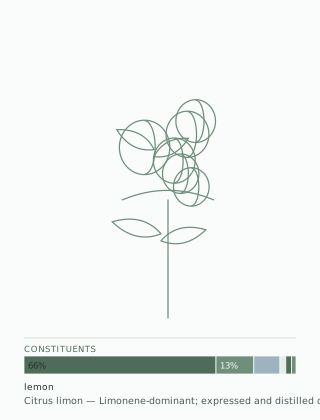
- Limonene 66%
- beta-Pinene 13%
- gamma-Terpinene 9%
- Sabinene 2%
- alpha-Pinene 2%
- Citral 1.5%
Storage & oxidation
Two things age this oil at once: the 66% limonene converts to limonene hydroperoxide, and the small citral fraction — an aldehyde pair — reacts and darkens. Cold-pressed lemon turns cloudy and then viscous as the non-volatile waxes precipitate. Eighteen months is the outside figure and twelve is more realistic for a partly used bottle.
Rotation & substitution
Lemon is the oil most often used in homemade cleaning sprays and in water bottles for "detox" — both of which are continuous or ingested exposures rather than occasional topical ones. Keep it to short, occasional topical use, and if you want a citrus for a daily blend, rotate to sweet orange or mandarin, which are slower to oxidise.
Adjacent materials
Distilled lemon
Steam-distilled lemon has the furanocoumarins removed and is not phototoxic
Litsea cubeba
A citral-rich oil with a lemon-sharp top note