Single-oil monograph
Lemongrass (Cymbopogon flexuosus)
- Phototoxic No phototoxicity
- Pregnancy Caution
- Pets Avoid
Published 2026-11-01 · adult ceiling 1% · shelf life 18 months
Lemongrass is 77% citral across its two isomers, which gives it the loudest, cheapest lemon note available and puts it at the top of the contact-dermatitis list. This site prints a 1% ceiling and no 2% or 3% row — the only oil in the collection treated that way alongside the phenols. Adult ceiling 1%, avoid around pets.
Safe dilution matrix
Rows are the concentration, columns are the audience. Each cell carries two lines: drops per 10 ml of carrier oil, and whether this site advises that combination. Figures come from 1 ml = 20 drops, and the bold row is the ceiling for this oil.
| Dilution | Per 30 ml | Adult | Child 6+ | Pregnancy | Pets |
|---|---|---|---|---|---|
| 0.5% | 3 | 1 drops ✓ advised | 1 drops ✓ advised | 1 drops ✗ not advised | 1 drops ✗ not advised |
| 1% | 6 | 2 drops ✓ advised | 2 drops ✗ not advised | 2 drops ✗ not advised | 2 drops ✗ not advised |
What each concentration is normally for: 0.5% — Facial blends, sensitive or broken skin, children 6-15, first patch test · 1% — Everyday adult body and massage blends, daily leave-on use · 2% — Short-term localised adult use, 7 to 10 days then re-assess · 3% — Adult ceiling for robust oils, small area, short course only
Contraindications & handling
✓ no restriction · ! caution · ✗ avoid. An avoid row means choosing a different material, not lowering the concentration.
- ! Pregnancy & breastfeeding — caution
- ! Children under 16 — caution
- ✗ Households with pets — avoid
- ✓ Epilepsy — ok
- ✓ Antihypertensive medication — ok
- ✓ Anticoagulant medication — ok
Four-step skin patch test
- Dilute 1 drop in 10 ml of carrier oil (0.5%) — lemongrass has a 1% ceiling, so 0.5% is the honest test level.
- Apply 1 drop of that blend to the inner forearm.
- Cover for 24 hours.
- Read at 24 and 48 hours. Citrus-grass oils are among the most common causes of contact dermatitis from essential oils; a positive here is meaningful.
Botanical record
- Family
- Poaceae · Poaceae
- Botanical part
- leaf
- Extraction
- steam-distillation
- Origin
- India (Kerala), Guatemala, Nepal, Madagascar
- Chemotype
- Citral-dominant (geranial + neral)
- Phototoxicity
- No phototoxicity
- Shelf life
- 18 months
Principal constituents
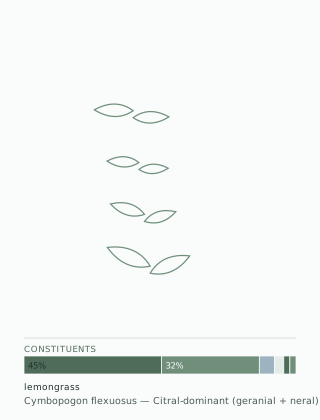
- Geranial (citral a) 45%
- Neral (citral b) 32%
- Geraniol 5%
- Geranyl acetate 3%
- Myrcene 2%
- Limonene 2%
Storage & oxidation
Citral is the least stable major constituent in this collection. It oxidises readily, and oxidised citral is both more irritating and more sensitising than fresh citral. Eighteen months is the figure here for a well-kept bottle, and it is worth buying 10 ml at a time and treating the oil as a perishable. A sharp, vinegar-like edge means it is finished.
Rotation & substitution
Lemongrass, citronella and lemon myrtle are all citral-dominant and rotate among themselves only on paper. Rotate lemongrass with a wood or a non-citral citrus, keep total use short, and treat it as a top note rather than a base — it is not an oil to use daily for months.
Adjacent materials
Citronella (Cymbopogon nardus / winterianus)
Also citral-led and also a 1% ceiling oil sold mainly as an insect repellent. Not a gentler swap; a lateral move within the same exposure group.