Single-oil monograph
Myrrh (Commiphora myrrha)
- Phototoxic No phototoxicity
- Pregnancy Avoid
- Pets Caution
Published 2026-10-04 · adult ceiling 2% · shelf life 60 months
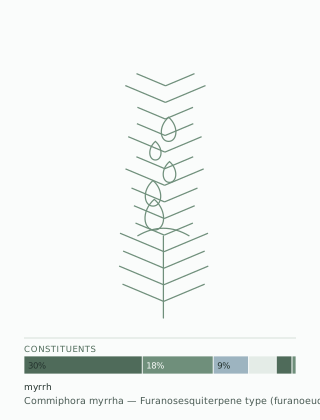
Myrrh is the furanosesquiterpene resin: 30% furanoeudesma-1,3-diene, 18% curzerene, and a two per cent adult ceiling. It shares a plant family with frankincense and, for that reason, much of its caution set — including the pregnancy row. This monograph covers the furan chemistry, the anticoagulant row and the mouthwash myth.
Safe dilution matrix
Rows are the concentration, columns are the audience. Each cell carries two lines: drops per 10 ml of carrier oil, and whether this site advises that combination. Figures come from 1 ml = 20 drops, and the bold row is the ceiling for this oil.
| Dilution | Per 30 ml | Adult | Child 6+ | Pregnancy | Pets |
|---|---|---|---|---|---|
| 0.5% | 3 | 1 drops ✓ advised | 1 drops ✓ advised | 1 drops ✗ not advised | 1 drops ✗ not advised |
| 1% | 6 | 2 drops ✓ advised | 2 drops ✓ advised | 2 drops ✗ not advised | 2 drops ✗ not advised |
| 2% | 12 | 4 drops ✓ advised | 4 drops ✗ not advised | 4 drops ✗ not advised | 4 drops ✗ not advised |
What each concentration is normally for: 0.5% — Facial blends, sensitive or broken skin, children 6-15, first patch test · 1% — Everyday adult body and massage blends, daily leave-on use · 2% — Short-term localised adult use, 7 to 10 days then re-assess · 3% — Adult ceiling for robust oils, small area, short course only
Contraindications & handling
✓ no restriction · ! caution · ✗ avoid. An avoid row means choosing a different material, not lowering the concentration.
- ✗ Pregnancy & breastfeeding — avoid
- ! Children under 16 — caution
- ! Households with pets — caution
- ✓ Epilepsy — ok
- ! Antihypertensive medication — caution
- ✗ Anticoagulant medication — avoid
Four-step skin patch test
- Dilute 1 drop in 5 ml of carrier oil (1%). Warm the bottle first so the drop is representative.
- Apply 2 drops to the inner forearm.
- Cover for 24 hours.
- Read at 24 and 48 hours. Myrrh contains furanosesquiterpenes and is one of the resins that produces a delayed reaction more often than a fast one.
Botanical record
- Family
- Burseraceae · Burseraceae
- Botanical part
- resin
- Extraction
- steam-distillation
- Origin
- Somalia, Ethiopia, Yemen, Kenya
- Chemotype
- Furanosesquiterpene type (furanoeudesma-1,3-diene, curzerene)
- Phototoxicity
- No phototoxicity
- Shelf life
- 60 months
Principal constituents
- Furanoeudesma-1 30%
- Curzerene 18%
- beta-Elemene 9%
- Lindestrene 7%
- delta-Elemene 4%
- Eugenol 1%
Storage & oxidation
A resin oil with a furanosesquiterpene skeleton: it resinifies rather than oxidising and keeps for years, thickening as it goes. Myrrh is often bought as a thick, dark liquid and is difficult to drop from a standard insert — warm the bottle in your hand, or use a pipette and record the weight instead of the drop count.
Rotation & substitution
Myrrh and frankincense are both Burseraceae resins with overlapping terpene chemistry, and people who react to one are more likely to react to the other. Rotate myrrh with a wood or root oil — sandalwood, vetiver, ginger — rather than with frankincense, and leave a gap between the two resins rather than using them in the same blend.
Adjacent materials
Opopanax (Commiphora erythraea)
A Commiphora relative sold as "sweet myrrh"
Frankincense (Boswellia sacra) · monograph
The obvious pairing and