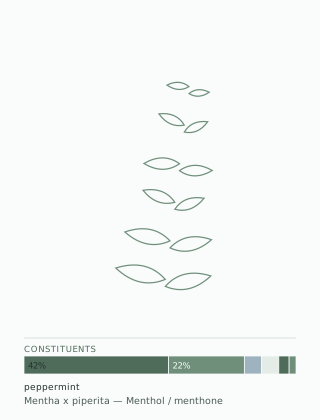
Single-oil monograph
Peppermint (Mentha x piperita)
- Phototoxic No phototoxicity
- Pregnancy Caution
- Pets Avoid
Published 2026-08-22 · adult ceiling 2% · shelf life 24 months
Peppermint is 42% menthol, and menthol is a drug in its own right — it activates the TRPM8 cold receptor directly. That is why it feels like it is working, and it is also why it gets used on infants and around the face, where it should not be. This monograph sets a 2% adult ceiling, explains the under-six rule, and separates the cooling from any claim about what the cooling is doing.
Safe dilution matrix
Rows are the concentration, columns are the audience. Each cell carries two lines: drops per 10 ml of carrier oil, and whether this site advises that combination. Figures come from 1 ml = 20 drops, and the bold row is the ceiling for this oil.
| Dilution | Per 30 ml | Adult | Child 6+ | Pregnancy | Pets |
|---|---|---|---|---|---|
| 0.5% | 3 | 1 drops ✓ advised | 1 drops ✓ advised | 1 drops ✗ not advised | 1 drops ✗ not advised |
| 1% | 6 | 2 drops ✓ advised | 2 drops ✓ advised | 2 drops ✗ not advised | 2 drops ✗ not advised |
| 2% | 12 | 4 drops ✓ advised | 4 drops ✗ not advised | 4 drops ✗ not advised | 4 drops ✗ not advised |
What each concentration is normally for: 0.5% — Facial blends, sensitive or broken skin, children 6-15, first patch test · 1% — Everyday adult body and massage blends, daily leave-on use · 2% — Short-term localised adult use, 7 to 10 days then re-assess · 3% — Adult ceiling for robust oils, small area, short course only
Contraindications & handling
✓ no restriction · ! caution · ✗ avoid. An avoid row means choosing a different material, not lowering the concentration.
- ! Pregnancy & breastfeeding — caution
- ✗ Children under 16 — avoid
- ✗ Households with pets — avoid
- ✓ Epilepsy — ok
- ! Antihypertensive medication — caution
- ! Anticoagulant medication — caution
Four-step skin patch test
- Peppermint stings. Dilute 1 drop in 5 ml of carrier oil before it goes anywhere near skin.
- Apply 2 drops to the inner forearm and wait five minutes before covering — severe stinging means stop.
- Cover and leave 24 hours.
- Read at 24 and 48 hours. Coolness is expected; burning, redness or a rash is not.
Botanical record
- Family
- Lamiaceae · Lamiaceae
- Botanical part
- leaf
- Extraction
- steam-distillation
- Origin
- United States — Washington and Oregon; also India
- Chemotype
- Menthol / menthone
- Phototoxicity
- No phototoxicity
- Shelf life
- 24 months
Principal constituents
- Menthol 42%
- Menthone 22%
- Menthyl acetate 5%
- 1 5%
- Menthofuran 3%
- Limonene 2%
Storage & oxidation
Menthol is a secondary alcohol and far more stable than linalool, so peppermint ages better than most herb oils. The failure mode here is different: menthofuran, the hepatotoxic furan present at 1-9%, rises as the oil oxidises, and an old bottle can be measurably worse on that axis than a fresh one. Buy 10 ml, not 100 ml.
Rotation & substitution
Peppermint's menthol is a Trigeminal irritant rather than a sensitiser, so rotation here is less about allergy and more about the mucous-membrane rule: do not use it near the face of anyone under six, and do not use it daily on the same area for months, because the cooling sensation masks an accumulating irritation.
Adjacent materials
Spearmint (Mentha spicata) · monograph
Carvone-dominant at roughly 60% with almost no menthol
Cornmint (Mentha arvensis)
Dementholised cornmint is the cheap industrial source of menthol; the natural oil runs 70-80% menthol and is markedly more aggressive. Check which one you have.