Single-oil monograph
Spearmint (Mentha spicata)
- Phototoxic No phototoxicity
- Pregnancy Caution
- Pets Avoid
Published 2026-09-22 · adult ceiling 3% · shelf life 24 months
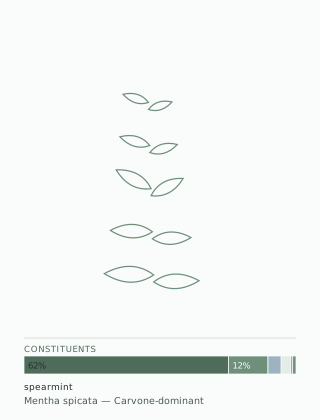
Spearmint is peppermint without the menthol: 62% carvone, roughly 0.5% menthol. That one difference is why it does not trigger the TRPM8 cold receptor, does not produce the respiratory reflex, and is the mint to reach for when peppermint is too much. It is still not an infant oil, and it is still a cat hazard.
Safe dilution matrix
Rows are the concentration, columns are the audience. Each cell carries two lines: drops per 10 ml of carrier oil, and whether this site advises that combination. Figures come from 1 ml = 20 drops, and the bold row is the ceiling for this oil.
| Dilution | Per 30 ml | Adult | Child 6+ | Pregnancy | Pets |
|---|---|---|---|---|---|
| 0.5% | 3 | 1 drops ✓ advised | 1 drops ✓ advised | 1 drops ✓ advised | 1 drops ✗ not advised |
| 1% | 6 | 2 drops ✓ advised | 2 drops ✓ advised | 2 drops ✗ not advised | 2 drops ✗ not advised |
| 2% | 12 | 4 drops ✓ advised | 4 drops ✗ not advised | 4 drops ✗ not advised | 4 drops ✗ not advised |
| 3% | 18 | 6 drops ✓ advised | 6 drops ✗ not advised | 6 drops ✗ not advised | 6 drops ✗ not advised |
What each concentration is normally for: 0.5% — Facial blends, sensitive or broken skin, children 6-15, first patch test · 1% — Everyday adult body and massage blends, daily leave-on use · 2% — Short-term localised adult use, 7 to 10 days then re-assess · 3% — Adult ceiling for robust oils, small area, short course only
Contraindications & handling
✓ no restriction · ! caution · ✗ avoid. An avoid row means choosing a different material, not lowering the concentration.
- ! Pregnancy & breastfeeding — caution
- ! Children under 16 — caution
- ✗ Households with pets — avoid
- ✓ Epilepsy — ok
- ✓ Antihypertensive medication — ok
- ✓ Anticoagulant medication — ok
Four-step skin patch test
- Dilute 1 drop in 5 ml of carrier oil (1%).
- Apply 2 drops to the inner forearm.
- Cover for 24 hours.
- Read at 24 and 48 hours. Unlike peppermint, a stinging sensation here usually means the carrier, not the oil.
Botanical record
- Family
- Lamiaceae · Lamiaceae
- Botanical part
- leaf
- Extraction
- steam-distillation
- Origin
- United States, China, India
- Chemotype
- Carvone-dominant
- Phototoxicity
- No phototoxicity
- Shelf life
- 24 months
Principal constituents
- L-Carvone 62%
- Limonene 12%
- 1 4%
- Dihydrocarvone 3%
- Menthol 0.5%
- beta-Bourbonene 1%
Storage & oxidation
Carvone is a ketone and resists oxidation; the limonene fraction at 12% is the part that turns. Expect the smell to move from sweet-mint toward a duller, slightly rubbery note at the end of its life. Two years, cool, capped, no half-empty bottles kept on a sunny shelf.
Rotation & substitution
Spearmint is the safer mint for anyone who finds peppermint too aggressive, but it is still a mint: it belongs in the same rotation slot, not in addition to peppermint. Use one or the other in a given blend, and swap mint families out every two to three weeks.
Adjacent materials
Peppermint (Mentha x piperita) · monograph
Menthol-dominant at 42% and much stronger on the TRPM8 receptor