Single-oil monograph
Rosemary (Salvia rosmarinus, cineole chemotype)
- Phototoxic No phototoxicity
- Pregnancy Avoid
- Pets Avoid
Published 2026-08-29 · adult ceiling 3% · shelf life 24 months
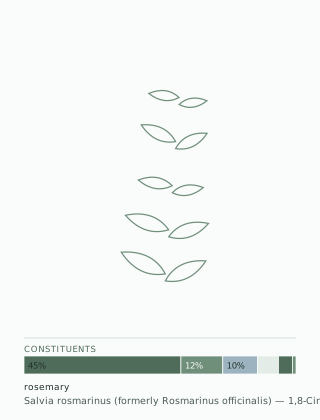
Rosemary is the clearest example on this site of why chemotype is not a marketing word: CT cineole is 45% 1,8-cineole and 10% camphor, CT camphor is 10% cineole and 25% camphor, and CT verbenone is something else again. They are sold under the same name, at the same price, and they belong to different risk categories. This monograph is written for the cineole type.
Safe dilution matrix
Rows are the concentration, columns are the audience. Each cell carries two lines: drops per 10 ml of carrier oil, and whether this site advises that combination. Figures come from 1 ml = 20 drops, and the bold row is the ceiling for this oil.
| Dilution | Per 30 ml | Adult | Child 6+ | Pregnancy | Pets |
|---|---|---|---|---|---|
| 0.5% | 3 | 1 drops ✓ advised | 1 drops ✓ advised | 1 drops ✗ not advised | 1 drops ✗ not advised |
| 1% | 6 | 2 drops ✓ advised | 2 drops ✓ advised | 2 drops ✗ not advised | 2 drops ✗ not advised |
| 2% | 12 | 4 drops ✓ advised | 4 drops ✗ not advised | 4 drops ✗ not advised | 4 drops ✗ not advised |
| 3% | 18 | 6 drops ✓ advised | 6 drops ✗ not advised | 6 drops ✗ not advised | 6 drops ✗ not advised |
What each concentration is normally for: 0.5% — Facial blends, sensitive or broken skin, children 6-15, first patch test · 1% — Everyday adult body and massage blends, daily leave-on use · 2% — Short-term localised adult use, 7 to 10 days then re-assess · 3% — Adult ceiling for robust oils, small area, short course only
Contraindications & handling
✓ no restriction · ! caution · ✗ avoid. An avoid row means choosing a different material, not lowering the concentration.
- ✗ Pregnancy & breastfeeding — avoid
- ! Children under 16 — caution
- ✗ Households with pets — avoid
- ✗ Epilepsy — avoid
- ! Antihypertensive medication — caution
- ! Anticoagulant medication — caution
Four-step skin patch test
- Dilute 1 drop in 5 ml of carrier oil (1%) — 1,8-cineole irritates neat.
- Apply 2 drops to the inner forearm.
- Cover for 24 hours.
- Read at 24 and 48 hours. A cool, tingling sensation is the cineole; burning is not.
Botanical record
- Family
- Lamiaceae · Lamiaceae
- Botanical part
- leaf
- Extraction
- steam-distillation
- Origin
- Tunisia, Morocco, Spain, France
- Chemotype
- 1,8-Cineole type (CT cineole); CT camphor and CT verbenone differ
- Phototoxicity
- No phototoxicity
- Shelf life
- 24 months
Principal constituents
- 1 45%
- alpha-Pinene 12%
- Camphor 10%
- Camphene 6%
- Borneol 4%
- Verbenone 1%
Storage & oxidation
Cineole and camphor are both oxidation-resistant, so rosemary ages slowly and rarely becomes a sensitiser through hydroperoxides. The limonene and pinene fractions — a combined 15-20% — do oxidise, so the usual rule applies: 24 months, cool, dark, capped.
Rotation & substitution
Rosemary is the oil most often used continuously on the scalp for months. Rotate it after two to three weeks with a different family entirely — lavender or atlas cedarwood — and do not combine it with peppermint or eucalyptus in the same blend, because that stacks three cineole- and menthol-type irritants on the same patch of skin.
Adjacent materials
Rosemary CT camphor
15-25% camphor
Eucalyptus radiata · monograph
Cineole-dominant too