Single-oil monograph
Tea tree (Melaleuca alternifolia)
- Phototoxic No phototoxicity
- Pregnancy Caution
- Pets Avoid
Published 2026-08-19 · adult ceiling 3% · shelf life 36 months
Tea tree is one of the very few essential oils whose composition is fixed by an international standard: ISO 4730 requires at least 35% terpinen-4-ol and no more than 15% 1,8-cineole. That standard exists because commercial tea tree was once adulterated and because the cineole fraction drives irritation. This monograph covers the skin ceiling, the 2019 hydroperoxide findings, and the household animals question.
Safe dilution matrix
Rows are the concentration, columns are the audience. Each cell carries two lines: drops per 10 ml of carrier oil, and whether this site advises that combination. Figures come from 1 ml = 20 drops, and the bold row is the ceiling for this oil.
| Dilution | Per 30 ml | Adult | Child 6+ | Pregnancy | Pets |
|---|---|---|---|---|---|
| 0.5% | 3 | 1 drops ✓ advised | 1 drops ✓ advised | 1 drops ✓ advised | 1 drops ✗ not advised |
| 1% | 6 | 2 drops ✓ advised | 2 drops ✓ advised | 2 drops ✗ not advised | 2 drops ✗ not advised |
| 2% | 12 | 4 drops ✓ advised | 4 drops ✗ not advised | 4 drops ✗ not advised | 4 drops ✗ not advised |
| 3% | 18 | 6 drops ✓ advised | 6 drops ✗ not advised | 6 drops ✗ not advised | 6 drops ✗ not advised |
What each concentration is normally for: 0.5% — Facial blends, sensitive or broken skin, children 6-15, first patch test · 1% — Everyday adult body and massage blends, daily leave-on use · 2% — Short-term localised adult use, 7 to 10 days then re-assess · 3% — Adult ceiling for robust oils, small area, short course only
Contraindications & handling
✓ no restriction · ! caution · ✗ avoid. An avoid row means choosing a different material, not lowering the concentration.
- ! Pregnancy & breastfeeding — caution
- ! Children under 16 — caution
- ✗ Households with pets — avoid
- ✓ Epilepsy — ok
- ✓ Antihypertensive medication — ok
- ! Anticoagulant medication — caution
Four-step skin patch test
- Dilute 1 drop of tea tree in 5 ml of carrier oil (1%) — do not test the neat oil.
- Apply 2 drops to the inner forearm and allow it to dry without rubbing.
- Cover with a plaster for 24 hours.
- Read at 24 and at 48 hours. Tea tree sensitises more often than its reputation suggests; a late reaction at 48 hours counts.
Botanical record
- Family
- Myrtaceae · Myrtaceae
- Botanical part
- leaf
- Extraction
- steam-distillation
- Origin
- Australia — northern New South Wales
- Chemotype
- Terpinen-4-ol type (ISO 4730)
- Phototoxicity
- No phototoxicity
- Shelf life
- 36 months
Principal constituents
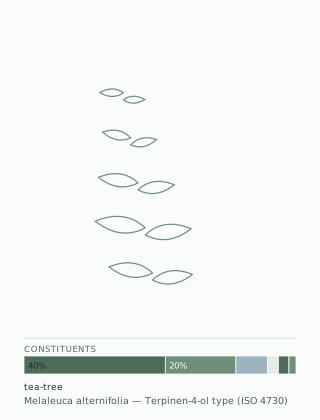
- Terpinen-4-ol 40%
- gamma-Terpinene 20%
- alpha-Terpinene 9%
- 1 3%
- alpha-Terpinolene 3%
- p-Cymene 2%
Storage & oxidation
Terpinen-4-ol is a tertiary alcohol and resists oxidation better than linalool, which is why tea tree is one of the few household oils that is often still usable at three years. The early marker is not the smell but the clarity — an oxidised tea tree goes slightly viscous and cloudy as the terpinene fraction polymerises into para-cymene and heavier products.
Rotation & substitution
Tea tree is the oil most often used continuously for months on the same spot. Rotate it after two to three weeks with manuka, niaouli or lavender, partly to limit exposure to the terpinene fraction and partly because continuous use on one area is the pattern that precedes most reported sensitisation.
Adjacent materials
Manuka (Leptospermum scoparium)
Richer in sesquiterpenes and higher in triketones
Niaouli (Melaleuca quinquenervia)
Same genus