Single-oil monograph
Bergamot (Citrus bergamia, expressed)
- Phototoxic Phototoxic
- Pregnancy Caution
- Pets Avoid
Published 2026-09-26 · adult ceiling 1% · shelf life 18 months
Bergamot is the most phototoxic oil in common household use, and it is also the one people are most reluctant to give up, because nothing else smells quite like it. Expressed bergamot carries bergapten at around 0.3% and the safest printable ceiling here is 1%, with 0.5% for anything that will see daylight. If you want more, the answer is the FCF version, not a higher percentage.
Safe dilution matrix
Rows are the concentration, columns are the audience. Each cell carries two lines: drops per 10 ml of carrier oil, and whether this site advises that combination. Figures come from 1 ml = 20 drops, and the bold row is the ceiling for this oil.
| Dilution | Per 30 ml | Adult | Child 6+ | Pregnancy | Pets |
|---|---|---|---|---|---|
| 0.5% | 3 | 1 drops ✓ advised | 1 drops ✗ not advised | 1 drops ✗ not advised | 1 drops ✗ not advised |
| 1% | 6 | 2 drops ✓ advised | 2 drops ✗ not advised | 2 drops ✗ not advised | 2 drops ✗ not advised |
What each concentration is normally for: 0.5% — Facial blends, sensitive or broken skin, children 6-15, first patch test · 1% — Everyday adult body and massage blends, daily leave-on use · 2% — Short-term localised adult use, 7 to 10 days then re-assess · 3% — Adult ceiling for robust oils, small area, short course only
Contraindications & handling
✓ no restriction · ! caution · ✗ avoid. An avoid row means choosing a different material, not lowering the concentration.
- ! Pregnancy & breastfeeding — caution
- ✗ Children under 16 — avoid
- ✗ Households with pets — avoid
- ✓ Epilepsy — ok
- ! Antihypertensive medication — caution
- ✓ Anticoagulant medication — ok
Four-step skin patch test
- Dilute 1 drop in 5 ml of carrier oil (1%). This is already the maximum printable concentration for expressed bergamot.
- Apply 2 drops to the inner forearm and let it dry.
- Cover for 24 hours and keep the arm fully out of the sun for 48 hours.
- Read at 24 and 48 hours. A streaked, burning reaction appearing on the second day is phototoxicity and means no sun-exposed use ever.
Botanical record
- Family
- Rutaceae · Rutaceae
- Botanical part
- peel
- Extraction
- cold-pressing
- Origin
- Italy — Calabria (over 90% of world supply)
- Chemotype
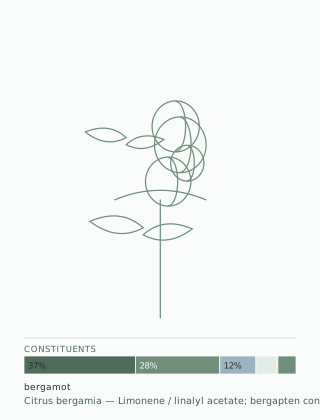
- Limonene / linalyl acetate; bergapten content drives the FCF question
- Phototoxicity
- Phototoxic
- Shelf life
- 18 months
Principal constituents
- Limonene 37%
- Linalyl acetate 28%
- Linalool 12%
- gamma-Terpinene 7%
- Bergapten (5-MOP) 0.3%
- beta-Pinene 6%
Storage & oxidation
Bergamot is 37% limonene and 28% linalyl acetate, so both the monoterpene oxidation route and the ester hydrolysis route are open, and the oil also contains bergapten which is unaffected by either. Eighteen months, refrigerated if possible, and discard on any vinegar note. Because the linalyl acetate fraction makes it smell 'fresh', oxidised bergamot is harder to catch by nose than oxidised lemon.
Rotation & substitution
Bergamot is the oil most often used daily in a "calming" blend, and that is the wrong pattern for it: daily use of an expressed phototoxic citrus means daily limonene exposure from an ageing bottle. Rotate it out after a week or two with neroli or petitgrain, which carry the same floral-citrus character with no furanocoumarins at all.
Adjacent materials
Bergamot FCF (furanocoumarin-free)
Bergapten reduced to below 0.001% by vacuum distillation or solvent extraction. Not phototoxic
Neroli (Citrus aurantium flower) · monograph
Same bitter-orange plant